Showing posts with label Imperialism. Show all posts

Tuesday, June 26, 2012

Posters from the May 1968 Paris Uprising

The May 1968 protests in France were a substantial event in labor history. The event is known as being the largest general strike in history, involving some of the first wildcat strikes, and virtually bringing the entire French economy to a halt. It involved over 11 million workers, 22% of the population of France, and lasted for two weeks. Aside from the historical impact it had, it also created some beautiful artwork. The ones shown below are from the student uprisings in Paris. 


-------------------------------------------------------------------------------------------------------------------------------
Titles from left to right going downward: 
  1. "The Beauty is in the Streets!"
  2. "United Workers!"
  3. "Capital"
  4. "Be Young and Shut Up" 
  5. "Peoples' University, Yes!"
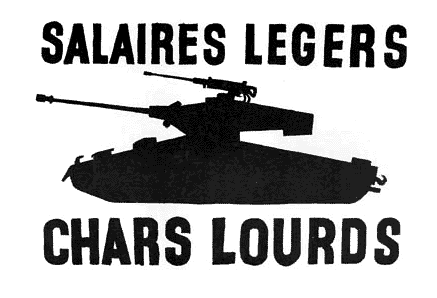
  6. "Light Wages, Heavy Tanks"

Thursday, June 21, 2012

The American War Obsession

Since its creation, the United States has virtually been involved in perpetual war. Specifically speaking however, militarization has especially escalated, and remained high, since World War II. 

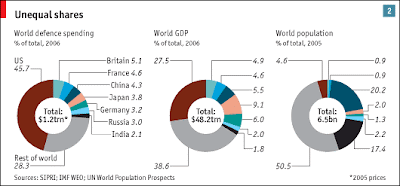
As of 2011, according to the Stockholm International Peace Research Institute, the United States accounts for 41% of the world's military spending -- spending roughly 711 billion dollars, accounting for roughly 5% of GDP. These statistics are troubling as is, but perhaps even more troubling is the stranglehold the military has on the American economy. Let's break down the facts, piece by piece. 

  • More than one-third of all scientists and engineers are engaged in military related jobs [Sato, 8].
  • Many industrial sectors are intertwined with military spending, the main two being aerospace and shipbuilding [Sato, 8].
  • Shipbuilding is heavily dependent on militarization. In 2002, shipbuilding brought in 11 billion in profits -- only 3.8 billion of this was from commercial shipbuilding [SCA, 1]. 
  • In total, based on 2001 data, the top 11 aerospace and defense corporations employ over 900,000 people [Sato, 9]. This number can only be assumed to have increased since the Afghanistan and Iraq wars. 
  • War-profiteering is high, especially in the last decade. To name one, Halliburton's KBR, Inc. division profited $17.2 billion from the Iraq War during 2003-2006 alone. More information can be found here.   
  • The arms trade in the United States is a multi-billion dollar industry. It accounts for roughly 39% of the total world market, ranking in 170 billion dollars from '03 to '10.
  • The top sellers are ironically 5 permanent members of the UN security council; U.S, France, China, Russia, and the UK. The majority of the buyers are developing nations.
  • Many U.S taxpayer subsidies go toward the arms trade as well. 
The United States is also a main supplier of foreign aid to other nations, especially military aid. As of 2010, much of it is allocated to Israel and Egypt.
  • Israel was given 3.2 billion U.S dollars in 2010, while Egypt was given 1.6 billion. However, there is little consistency; West Bank/Gaze was given 69 million in aid and other Middle Eastern states are given upwards of 100s of millions of dollars to essentially "leave Israel alone." 
  • Certain regions also are heavily funded. 3.3 billion U.S dollars were allocated, for example, to South and Central Asia, however that is minuscule to the total combined amount given to Egypt and Israel. 
Based on 2007 statistics
As percent of federal spending (2007)
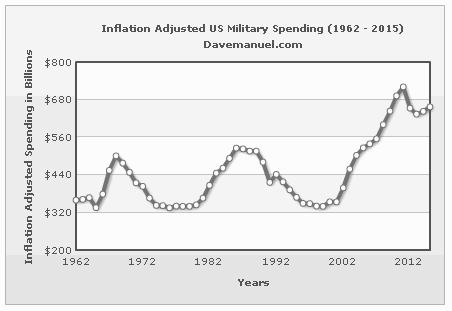
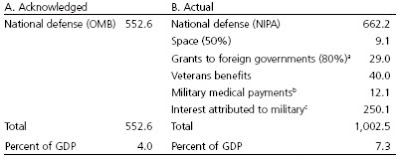
The issue with looking at American military spending is that much of it is withheld and convoluted. When military space expenditures, veteran payments, foreign aid, and other military-related costs are added in, the total actual budget is much higher than what was mentioned earlier in this post -- surpassing 1 trillion U.S dollars. Moreover, the percentage of federal spending is also misleading if taken at face value; it also includes transfer payments, such as social security and medicare, which are self-financed and do not use income tax revenue. The actual military spending curve shown to the right takes this into consideration. Keeping this in mind, GDP and budget percentages soar to shocking levels.

Equally disheartening, though, is the effect this has had on poverty in the United States. There is a correlation, in recent years, to war spending and individuals living under the poverty threshold. 


Fundamentally, this all of this is a reason for concern. With the United slipping from the economic dominance it once had, will it be forced to resort to military bullying to stimulate its industrial sectors and to maintain its intentional prestige? Although high military spending has been a staple in American policy for decades, it has spiked in recent years -- and since the Cold War and the fall of the Soviet Union, the political machine is promoting it quite overtly since now it has little reason to hide. Frankly, using militarism to promote imperial ends must cease -- there is much blood on American hands, and fostering success through war is both inhumane and unsustainable. All great empires collapse by overreaching its boundaries, due to excessive military budgets and overly-ambitious expansionist interests. The United States is on the path to be doomed to a similar fate if this jingoistic culture persists.

----------------------------------------------------------------------------------------------------
- Sato, Eiko. Culture of Peace: Rediscovery of Human Innate Potential and Capability for Peacefulness: Culture of Peace and Violence in the United States. Honolulu: University of Hawaii Library, 2005. Web.
- Shipbuilders Council of America. Economic Contribution of U.S Commercial Shipbuilding Industry. Washington D.C: , 2002. Web. 
- The actual military figures were acquired from an article titled "U.S Imperial Triangle and Military Spending" from the Monthly Review.
- The written manuscript of Martin Luther King Jr.'s speech titled "Why I am Opposed to the War in Vietnam."
- A relevant article that provides more insight: U.S Military Industrial Complex: Profiting from War

Tuesday, March 20, 2012

Colonialism in the 21st Century

In modern history courses, it is implied the age of colonialism ended after the decolonization of Africa in the years after WW2. After the mass exploitation of indigenous persons, the destruction of their cultures, and the genocide of their peoples - the Western powers are sorry for what they've done, and they've shown their gratitude by leaving them to their own. The "White Man's Burden" is over; we've changed.

But what do we make of the humanitarian wars and the imposed economic globalization through international institutions? Is this something to embrace, or is it rather neocolonialism "with a human face?" 


If there is one thing we can learn from the tragedy of 19th and 20th century colonialism is that the interests are seldom explicitly stated. It is illustrated as the noblest of causes; it was the duty of 'civilized' to help those less fortunate and rid them of their immoral cultures. It is this relationship between the colony and the colonizers that is seemingly most dangerous, and established cultural hegemony [a term borrowed from Anton Gramsci's writings] on those under occupation, making them disillusioned of what the future held. In of itself, this creates an atmosphere of implied prejudice and dependence that severely dismantles the cultural balance and solidarity among the peoples of that area. On a tangible level it strips them of their natural resources, impoverishing them, and leaving them to wallow in their suffering.
On the topic of the noble portrayal of colonialism - each Empire had their own distinct form of doublespeak used for garnering support. For the French and Portuguese it was the "civilizing mission," all in effort to tame the 'backward people' in order to forcibly assimilate them into the social mores of the respective empire. For the Americans, and the British also, it was predominately the "White Man's Burden" based on a poem by Rudyard Kipling which portrayed the imperialism as a noble enterprise and seemingly divinely sanctioned. For other empires, their reasons were almost explicitly nationalistic with little 'noble' justification. The German and Italian Empires both wanted their "place in the sun," especially Germany after Kaiser Wilhelm II's rise to power and his doctrine of Weltpolitk. The Japanese empire was the only non-western imperialistic power and they based their doctrine on anti-western ideals and nationalism; the foreign policy of the Shōwa period was dominated by the concept of the "Greater East Asia Co-Prosperity Sphere" which attempted to create a domineering Japanese presence in Eastern Asia. It's underlying motive was similar to that of the American ideology of "Manifest Destiny" and many Japanese felt it was self-evident they would expand after the many wars Japan engaged in, particularly with China and Russia. 


Not surprisingly so, much of the language used during the apex of what I call 'classical modern colonialism' is still prevalent today, albeit in a different more obscure context. The public reasons for militarization and dominance have changed and the functions of a physical empire have exhausted their use; however, the motivations for a commercial one are still very present in policy - and the reasoning may very well be very much the same; It is the public admission that we're "civilizing" them, but not with culture this time [as least not directly], but rather with "democracy" and "liberal capitalism." This was the justification for American-backed coups d'état of the 20th century, to eliminate any threat to American hegemony on the global stage, which was then communism. It was driven by fear and perhaps even more fundamentally 'American Exceptionalism' of which is staple of any imperialistic power. The reality of the Iraq War, the United States' current occupation of Afghanistan, and the drone strikes all over the Middle East only enforces that this concept is still very fresh in the minds of American policymakers. It seems Americans have already forgot the tragedy of Vietnam, which they swore they would never allow to happen again. Noam Chomsky described the danger of this anomaly as such:
"Historical amnesia is a dangerous phenomenon, not only because it undermines moral & intellectual integrity, but also because it lays the groundwork for crimes that lie ahead.."
And in this respect, I cannot agree more. Historical amnesia and an ignorant public is always benefit to the policymakers - it is institutionalized ignorance and a product of exactly how the system was created to function in an effort to engineer a passive social order, and the assumed 'benevolence' of today's major powers is only the tip of the iceberg sadly enough.

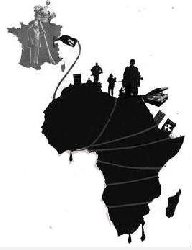
Aside from the United States, Western Europe is engaging in very similar neo-imperial activity to maintain at least some form of economic, political, or military control on the former colonies. France's policy of Françafrique, which was once hailed to be a mutually beneficial relationship, is inherently exploitative. France's supporting, and subtle funding, of resource-rich dictatorships such as that of the Democratic Republic of Congo [dictatorship until 1997] and Gabon [whose dictator died in 2009, but his son is now in power] are dissuading and rendering it near impossible for the native people there to establish their own system. This populist disconnect from policy and reality is a feature created by the former colonizers and was mostly promulgated during the Cold War, with the establishment of anti-Communist dictatorships, but is still very much a systemic staple of Western foreign policy today; all done in the name of safety, democracy, and 'moral doctrines.'

Although current French President Sarkozy has attempted to distance himself from Françafrique, it's implications are still felt and still being pursued. France has been in more military operations in the past few years than it has been in the last 50; its intervention in its former colony Ivory Coast, its intervention in the Libyan Civil War (which it conducted before the emergency meeting of Western powers in Paris), its co-opting [with the U.S primarily] of the 2004 Haitian coup d'état of former president Jean-Bertrand Aristide, its troop deployment into the former French colony of Chad, and its military involvement in the Afghanistan War. All of these, claimed to be purely humanitarian wars, have much of the criteria of a neo-colonial mentality - and aims at establishing French (or Western) dominance in these regions of the world.

And perhaps equally commercially imperialistic is the World Bank and the WTO, where the World Bank gives loans to autocratic regimes in the Third World, only to see that money go to waste and then asking the WTO to demand repayments; which always comes in the form of severe cuts for programs necessary for those not in power. It is this dynamic that is exploitative and ultimately prevents these nations from ever reaching real global status, among other things.

Seemingly so, ignorance always benefits the state - and that certainly holds true in this case. The disillusionment of the public on foreign policy is rather frightening, and the imperial trends will continue to be cyclic and unbroken until it is realized. I take an anti-imperialist stance from an ethical, philosophical, and morally-pragmatic perspective; because the self-determination of peoples in realizing their own destinies cannot be undermined, no matter how elusively humble the cause or how great the safety that is promised thereafter.