Showing posts with label Debt. Show all posts

Monday, August 6, 2012

Debt Deflation and Crisis

When analyzing debt and economic growth, usually only government debts are examined. They are seen as a corollary to economic crises, devaluation of currencies, and government defaults -- and while I'm not going to dispute or discuss these claims here in this post, perhaps on a later day, I will say that they are misleading trends of analyses in relation to the current financial crisis. There is another 'kind' of debt that is up for discussion and more pertinent to the crisis of 2007 -- credit market debt, which consists of domestic non-financial sectors (household debt, business/corporate debt, and government debt) and domestic financial sector debt.

This explosion of credit began around the time of the institution of 'Reaganomics,' where individuals took to lending and spending over saving despite stagnant wages. 


A more detailed look of the trend since 2002, with its peak. The shaded area depicts the length of the recession.


However, the above graphs show the total credit market debt. Broken down, household (consumer) credit debt depicts the same trend.


What does all this mean? Fundamentally, this means that the expansive economic growth of the previous three decades were on shaky footing to begin with, likely leading to the global economic collapse that followed. The impact of the credit boom since the 1980s is described in an article by the research institute Center for American Progress (CAP) by Christian E. Weller. He writes:
"The debt is highest among the middle class. Middle-income families before the crisis had a debt-to-income ratio of 155.4 percent in 2007, the last year for which data are available, for families with incomes between $62,000 and $100,000, which constituted the fourth quintile of income in our nation in 2007. This ratio is higher than for any other income group. Families in the top 20 percent of income (with incomes above $100,000) had a ratio of debt to income of 123.6 percent, and families in the third quintile (with incomes between $39,100 and $62,000) owed 130.7 percent of their income. Households in the bottom 40 percent of the income distribution (with incomes below $39,100 in 2007) owed well below 100 percent of their income."
Shocking as it is, this is the not the first time such a credit upsurge occurred. There was a similar phenomenon that occurred before the Great Depression of the 30s. Samuel Brittan, in his review of Richard Duncan's 'The New Depression: The Breakdown of the Paper Money Economy,' writes:
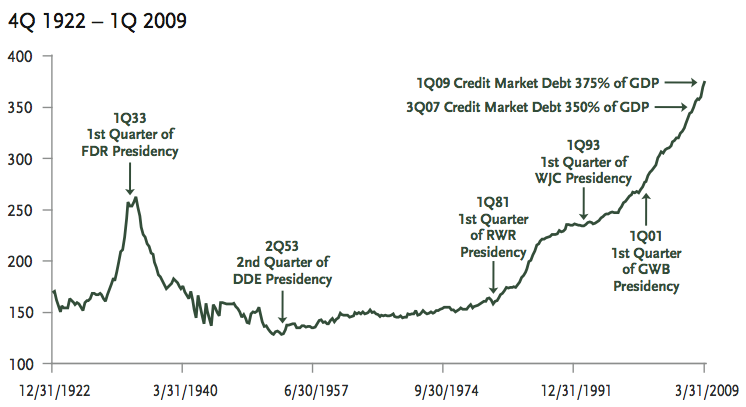
"It is certainly striking how both the 1929 Wall Street crash and the 2007-08 financial crisis were preceded by a huge credit explosion. Credit market debt as proportion of US gross domestic product jumped from about 160 per cent in the mid-1920s to 260 per cent in 1929-30. It then fell sharply in the 1930s to its original position. Later it surged ahead in two upswings after 1980 to reach 350 per cent of GDP in 2008."
The corresponding graphic, using the analysis by Jeffrey Gundlach, Chief Investment Officer from TCW:


This analysis of crises in relation to credit market debt is attributed to economist Irving Fisher, and his ideas were largely ignored in favor of mainstream Keynesian view of economic crises, which argued that they were caused by an insufficiency of aggregate demand. Since the recent economic crash of 2007, Fisher's ideas have enjoyed a resurgence in economic thought. His theory on debt deflation has been of significant fascination in the heterodox Post-Keynesian school of economics, and is now beginning to enter the mainstream. Economist Paul Krugman discusses Fisher's ideas in one of his posts on his blog "Conscious of a Liberal" in the NY Times -- below is the graphic taken from the article (with added information).      

                         
Since the total credit market debt owed has been stagnant since late 2009, reaching its 'peak,' and if GDP steadily keeps rising, it is likely that debt deflation will occur all the same as it did during the Great Depression. However, the issue of private debt and its hindrance on the consumer is still an issue -- and if spending is ever to increase significantly, the issue of wages and consumer debt must be addressed.
------------------------------------------------------------------------------------------------------------
- An analysis of the total credit market debt by Crestmont Research. 

Saturday, July 21, 2012

A Brief History of Privatization in Croatia

A month or so ago, Anton posted a piece which detailed the economic history of Yugoslavia (you can find that here). This is the second half to the same paper, which I collaborated with him. This portion focuses on Croatia's post-independence transition to capitalism and explores the efforts of privatization undertaken by the its government after the collapse of Yugoslavia. This is a topic which fascinates me, so I may potentially post more research in the future.

I. Post-Independence Recovery and Privatization

After Croatia declared independence in 1991, it would have to begin to deal with the burgeoning economic troubles at hand. The war which broke out as a result of Croatia declaring independence took its toll on the economy, which was in dire straits when Franjo Tuđman was elected president. Tuđman’s presidency would serve as the herald for economic views which now play a large role in the modern Croatian government; privatization and globalization. However, the maladministration of privatization would join a long list of causes of economic problems including damage to infrastructure caused by the war, the refugee population, and disturbance of macroeconomic relationships.
Croatia had to overcome two major Yugoslavian legacies in order to properly de-nationalize the country’s economy. Self-management and social ownership were the foundations of Yugoslavian socialism [Franičević 6]. Although dismantling the socialist state was not a popular opinion in the late 1980s, early legislation arose, outlining privatization measures with the goal of benefitting Croatian workers. These initial premises of privatization legitimized the institution in terms of popular opinion. As far as the workers were concerned, “they were the real ‘owners’ of the firm[s]… the obtaining of widespread support for privatization among the working class was regarded as an essential element in its successful implementation” [Franičević 7]. What most Croatians failed to realize, however, was that President Tuđman’s Croatian Democratic Union was the single-party entity which made the system possible. In order to begin to renovate the economy, the Law on the Transformation of Socially Owned Enterprises was enacted. There were two stages to this approach; the first was the transformation of social ownership into private or state ownership, the second was the complete privatization of said state ownership [Franičević 9].

Several of the procedures of the first stage proved to be relatively successful, by the end of 1996 the public debt had been reduced by over 1.8 billion Deutsche Marks [Franičević 12]. However, major difficulties arose with the privatization process, which drew criticism since the process was nontransparent, power was concentrated in a single ruling party, nepotism was prevalent, and blatant corruption plagued the system. The privatization model was constructed in anticipation of foreign capital. This would have been the ultimate goal of the two-phase process; initially, previously nationalized industry would be sold to the private sector and the state, and if all had gone as planned, international corporations would buy into Croatia’s industries. Unfortunately, the corruption of Tuđman’s government made Croatia’s economy extremely volatile, and not one which foreign investors would so readily invest in. Nevertheless, privatization continued throughout the 1990’s until Tuđman’s death in 1999. Its institution wreaked havoc on the Croatian economy, and it was a testament to the dangerous power of uncontrolled state capitalism. Croatian privatization contrasted similar processes in other European nations at the time. A majority of Croatia’s capital was due to the hotel industry, however, throughout the 1990’s, the tourism industry shrunk as a result of violence in the early part of the decade, and economic decline in the latter half. Another difference was due to Tuđman’s strict nationalist control. Because of Croatia’s strong nationalist sentiments, they began to distance themselves from the Balkan states and became ambitious in wanting to be seen as a “Western State”. Tuđman was able to take advantage of this cultural Westernization and apply it to the economic policies of his administration. Whereas privatization by definition should result in less state control, Tuđman’s presidency virtually resulted in quite the opposite. He relied on the state, rather than the private sector of the economy, in order to globalize the country’s economy; however, it was an exercise in futility due to corruption, scandals, and the buying out of Croatia’s capital and industries.

II. Growth in the New Millennium

In spite of the tragedy and controversy that surrounded Tuđman and the Croatian Democratic Union’s privatization scheme, the economy began to take a turn for the better in 2000. With the Croatian Democratic Union defeated in the 2000 elections, structural reforms under Prime Minister Ivica Račan were finally possible. For the three years he was in power, he continued privatization by opening up the economy to the West, which helped to restart Croatia’s GDP growth. Račan also began programs to improve infrastructure, which was essential in assisting the rejuvenation of tourism. After nearly being destroyed in the 1990’s, the industry has steadily increased since 2000, with the inflow of capital further funding infrastructure. Inflation remained stable as well, with the Croatian Kuna maintaining stability with the Euro. Overall, the expansion of the economy was due to said infrastructure programs, Westernization of the markets and tourism, as well as the growth of smaller private corporations. In the nine years from 1999 to 2008, GDP increased by around 4.25% per year.

Croatia’s growth in GDP in the 2000’s was an excellent sign of improvement for the country’s economy; however it failed to match the growth in Yugoslavia in the 50’s, 60’s, and early 70’s. Although Croatia remains one of the wealthiest of the former Yugoslav republics, the damage caused by the economic collapse of the 1990’s and subsequent economic policies have left impacts on Croatia on both micro and macroeconomic levels. The unemployment rate in 2011 was 17.9%, with a comparable 18% of Croatians living below the poverty line as of 2009. Even during the dusk of Socialist Yugoslavia, the unemployment rate was lower, at 15%. Although life expectancy and literacy rate have risen to 76 and over 99% respectively, provinces like Krajina are particularly devastated by unemployment. In addition, Croatia’s domestic economy is in need of repair, as it relies far too much on imports and its export sector is minimal.

During a meeting with the U.S. Ambassador to Croatia in February of 2010, Minister of Economy Duro Popijac summarized the major issues which the nation faces. First is the privatization of shipyards. During Yugoslav socialism, shipbuilding was one of the largest economic sectors, and the Croatian government is currently having difficulty selling the shipyards. Until they are bought, the government must continue to pay to keep them open, which is something the European Union does not permit. Croatia’s candidacy for the EU affects its economy in a big way, as it is doing almost all that it can to meet the Union’s requirements. Minister Popijac highlighted a three-part economic bailout fund, which would include a subsidized loan scheme, government guarantee fund, and the creation of a private equity fund. A majority of Croatia’s microeconomic problems stem from the ineffectualness of government intervention in the private sector, as well as ongoing corruption. All of these, in turn create macroeconomic issues, as they make Croatia an increasingly unstable investment opportunity.

III. The Current Dilemma & What the Future Holds

The transformation from Yugoslav socialism to modern Croatian capitalism has stretched over half a century. There were a myriad of changes from one extreme to another; the hasty implementation of privatization is perhaps to blame for Croatia’s current economic troubles. This increased Croatia’s interdependence with other European nations after the Yugoslav Civil Wars, rather than fostering its own industrial-based economy. Furthermore, additional privatization has essentially become the only way out of Croatia’s economic dilemma in their eyes, despite it being what caused the economy to become so unstable. The ultimate root of Croatia’s economic problems, however, is cultural. The current policies are not working, yet there is hardly any opposition. Croatia yearns to further westernize themselves and their economy, to the point where their extreme nationalism is beginning to hinder progress and harm them. The nation is taken by the allure of pure capitalism, further fueled by their desire to join the EU, and there is no tolerance or consideration for any other economic viewpoints. Although Croatia’s economy appears to be relatively growing, successful measures need to be taken to address their high foreign debt, weak industrial export sector, crumbling bureaucracy, and large reliance on tourism. Until those issues are addressed in a more open minded way, Croatia will never be free of its economic dependency on stronger powers.

----------------------------------------------------------------------------------------------------------------------------------
-Ballinger, Pamela. "Selling Croatia or Selling Out Croatia?" Bowdoin College, 24 Oct. 2003. Web.
-Franičević, Vojmir. "Privatization in Croatia: Legacies and Context". Eastern European Economics, Vol. 37, No. 2 (Mar.-Apr., 1999), pp 5-54
-Government of the Republic of Croatia - Information on Croatian Economy 

Monday, April 2, 2012

The Credit Illusion

It seems that the United States has grown economically, for the most part, throughout all of its history. And for much of its history, this growth was accompanied by corresponding increases in real wages. It was assumed that with economic growth, the purchasing power of your wage for all your hard work would pay off and it would increase with time; it was part of the American Dream.


Ever since the 60s, real wages have remained mostly stagnant  - even taking a downward trend in the past year. Although maybe our nominal wages have increased, our real wages have remained the same and even more alarming the purchasing power of income has plummeted. Even worse so, the price of food and energy has gone up in recent years and we're still working the same amount of hours, sometimes more. Where is the improvement and, most importantly, why is the middle class shrinking? Although all this issues would usually mean a rise in unionization amongst workers and rallies to demand for higher wages/benefits and perhaps more equal distribution of wealth, as happened during the Great Depression and the 1910s, union membership has actually paradoxically decreased in the last 50 years.The Bureau of Labor Statistics reports that only 6.9% of workers in the private sector are union members. 


Although I've oftentimes heard the right demonize unions as dangerous to the delicate fabric of a free market, and oftentimes advocate enacting legislation to curb their power, there is no question the decrease in union membership has had a direct effect on the concentration of wealth in the United States and the middle class share of aggregate income. Here is are the results that were found by Karla Waters and David Madland of the at the Center for American Progress (CAP):


Now, before I get to the credit illusion, which is likely the culprit, first we have to dispel a few arguments against the stagnation of real wages in the United States - three of them specifically I want to talk about;

Q: Well, maybe workers' productivity has not increased and their real wages are a direct result of a stagnation in their output?

This cannot be true, hourly outputs per workers have actually been steadily increasing. This is based on information from the Bureau of Labor Statistics and Bureau of Economic Analysis; there is indeed a growing gap between output and real wages: 


Q: The average income per household has gone up, isn't that inconsistent in the stagnation of real wages? 

No, it is not. The Second Wave of feminism, which started in the early 60s, brought many more women to the workforce. It's not that the workers are bringing more real income home, it's that more people are working in the household. In an article in the journal article by Rebecca A. Clay of the American Psychological Association:
In 1940, according to the Employment Policy Foundation's Center for Work and Family Balance, 66 percent of working households consisted of single-earner married couples. By 2000, that percentage had dropped to less than 25 percent. By 2030, the center estimates, a mere 17 percent of households will conform to the traditional "Ozzie and Harriet" model.
It is this phenomenon that has caused an increase in average income per household - there are now many more new sources income per family, but that doesn't necessarily tell us anything about the average real wage for each individual bringing it home.

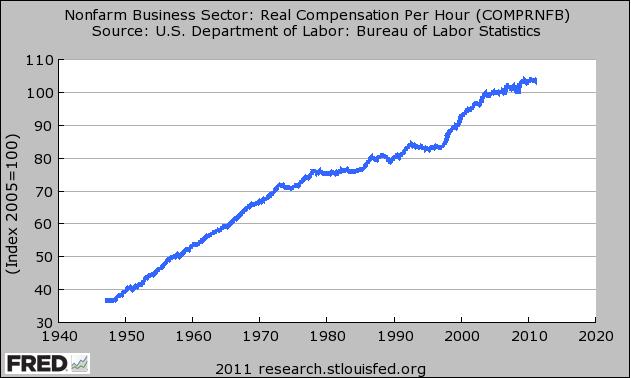
Q: You are not adding benefits to the real wage. The Bureau of Labor statistics has shown there has been a upward trend in real compensation per hour since the 1940s. Does this not explain the stagnation of wages?

It is true there has been a steady increase of real compensation (wages + benefits) per hour, below is a graph taken from the Bureau of Labor Statistics;


However, we have to look at this data with the increase in workers' output rather than by itself. Since the year 2000, there has been especially a disconnect between real compensation per hour and output. 


But this disconnect in average hourly compensation and productivity started far before the 00s; it actually began in the late 70s and got progressively worse since the Reagan years. Below is a graph from the Economic Policy Institute;


And although this graph does not show the growing gap between productivity and average hourly compensation since '07, it has gotten much worse since then. So yes, average hourly compensation has been increasing but not as nearly as the same rate as productivity has. 

-------------------------------------------------------------------------------------------------------------------------------

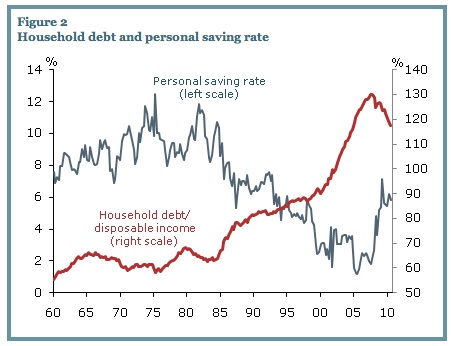
Now, for the topic of this post which may actually be shorter than the background information; Why aren't the workers mobilizing and demanding higher wages as they did in the first half of the 20th century? There are many reasons; one being the destruction of unionism during the Reagan years and another being the of spending money you don't actually have; the illusion of credit. Ever since real wages have become stagnant and the sharp decline of unionization in the 80s, there has been a sharp increase in household debt in the United States, which actually dissuades workers from demanding higher wages in some respects. It is this exploitative dichotomy that has kept corporate profits high and wages low; all in the guise of "buy now, pay later!" and 'economic growth.

Below is a graph of household debt versus persona savings taken from 'The Basis Point,' a blog by mortgage banker Julian Hebron:  


Here is a chart taken from the Federal Reserve Bank of San Francisco. It was a study pertaining to the entire United States:


Why is the middle class shrinking and being anesthetized by credit? It is this type of behavior that drives society outside of its means and gives it working class families the false perception that their wages are increases; maybe nominally they are, which is deceptive in itself, but the main hurdle we must overcome is realizing the distraction of mass consumption by credit going forward. This requires questioning this entire system which has, for the most part, become based on credit and money yet to be paid. I highly fear the collapse of this 'credit culture' and the shaky foundation it is built on; And perhaps worst of all, we are unjustly condemning future posterity to debt bondage. What happened during the crisis of 2008 we may find to become a staple in the modern 21st century economic model; and since debt wasn't properly liquidated, worse may be yet to come. The functionality of such an illusionary market method I am highly skeptical of, and its outcome will most definitely hurt the current mainstream liberal capitalist model.