Showing posts with label Economics. Show all posts

Monday, August 6, 2012

Debt Deflation and Crisis

When analyzing debt and economic growth, usually only government debts are examined. They are seen as a corollary to economic crises, devaluation of currencies, and government defaults -- and while I'm not going to dispute or discuss these claims here in this post, perhaps on a later day, I will say that they are misleading trends of analyses in relation to the current financial crisis. There is another 'kind' of debt that is up for discussion and more pertinent to the crisis of 2007 -- credit market debt, which consists of domestic non-financial sectors (household debt, business/corporate debt, and government debt) and domestic financial sector debt.

This explosion of credit began around the time of the institution of 'Reaganomics,' where individuals took to lending and spending over saving despite stagnant wages. 


A more detailed look of the trend since 2002, with its peak. The shaded area depicts the length of the recession.


However, the above graphs show the total credit market debt. Broken down, household (consumer) credit debt depicts the same trend.


What does all this mean? Fundamentally, this means that the expansive economic growth of the previous three decades were on shaky footing to begin with, likely leading to the global economic collapse that followed. The impact of the credit boom since the 1980s is described in an article by the research institute Center for American Progress (CAP) by Christian E. Weller. He writes:
"The debt is highest among the middle class. Middle-income families before the crisis had a debt-to-income ratio of 155.4 percent in 2007, the last year for which data are available, for families with incomes between $62,000 and $100,000, which constituted the fourth quintile of income in our nation in 2007. This ratio is higher than for any other income group. Families in the top 20 percent of income (with incomes above $100,000) had a ratio of debt to income of 123.6 percent, and families in the third quintile (with incomes between $39,100 and $62,000) owed 130.7 percent of their income. Households in the bottom 40 percent of the income distribution (with incomes below $39,100 in 2007) owed well below 100 percent of their income."
Shocking as it is, this is the not the first time such a credit upsurge occurred. There was a similar phenomenon that occurred before the Great Depression of the 30s. Samuel Brittan, in his review of Richard Duncan's 'The New Depression: The Breakdown of the Paper Money Economy,' writes:
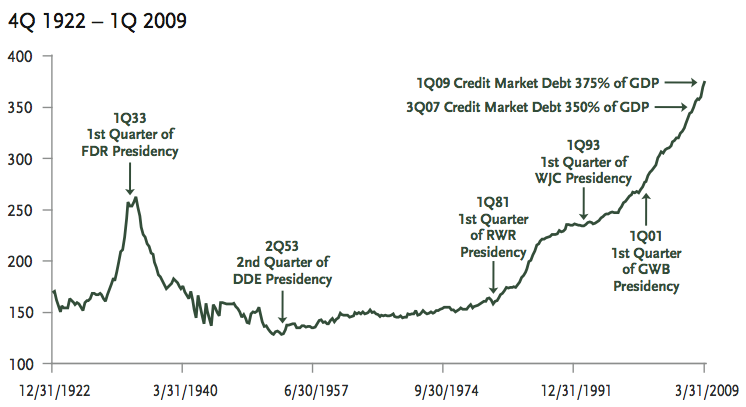
"It is certainly striking how both the 1929 Wall Street crash and the 2007-08 financial crisis were preceded by a huge credit explosion. Credit market debt as proportion of US gross domestic product jumped from about 160 per cent in the mid-1920s to 260 per cent in 1929-30. It then fell sharply in the 1930s to its original position. Later it surged ahead in two upswings after 1980 to reach 350 per cent of GDP in 2008."
The corresponding graphic, using the analysis by Jeffrey Gundlach, Chief Investment Officer from TCW:


This analysis of crises in relation to credit market debt is attributed to economist Irving Fisher, and his ideas were largely ignored in favor of mainstream Keynesian view of economic crises, which argued that they were caused by an insufficiency of aggregate demand. Since the recent economic crash of 2007, Fisher's ideas have enjoyed a resurgence in economic thought. His theory on debt deflation has been of significant fascination in the heterodox Post-Keynesian school of economics, and is now beginning to enter the mainstream. Economist Paul Krugman discusses Fisher's ideas in one of his posts on his blog "Conscious of a Liberal" in the NY Times -- below is the graphic taken from the article (with added information).      

                         
Since the total credit market debt owed has been stagnant since late 2009, reaching its 'peak,' and if GDP steadily keeps rising, it is likely that debt deflation will occur all the same as it did during the Great Depression. However, the issue of private debt and its hindrance on the consumer is still an issue -- and if spending is ever to increase significantly, the issue of wages and consumer debt must be addressed.
------------------------------------------------------------------------------------------------------------
- An analysis of the total credit market debt by Crestmont Research. 

Saturday, July 21, 2012

A Brief History of Privatization in Croatia

A month or so ago, Anton posted a piece which detailed the economic history of Yugoslavia (you can find that here). This is the second half to the same paper, which I collaborated with him. This portion focuses on Croatia's post-independence transition to capitalism and explores the efforts of privatization undertaken by the its government after the collapse of Yugoslavia. This is a topic which fascinates me, so I may potentially post more research in the future.

I. Post-Independence Recovery and Privatization

After Croatia declared independence in 1991, it would have to begin to deal with the burgeoning economic troubles at hand. The war which broke out as a result of Croatia declaring independence took its toll on the economy, which was in dire straits when Franjo Tuđman was elected president. Tuđman’s presidency would serve as the herald for economic views which now play a large role in the modern Croatian government; privatization and globalization. However, the maladministration of privatization would join a long list of causes of economic problems including damage to infrastructure caused by the war, the refugee population, and disturbance of macroeconomic relationships.
Croatia had to overcome two major Yugoslavian legacies in order to properly de-nationalize the country’s economy. Self-management and social ownership were the foundations of Yugoslavian socialism [Franičević 6]. Although dismantling the socialist state was not a popular opinion in the late 1980s, early legislation arose, outlining privatization measures with the goal of benefitting Croatian workers. These initial premises of privatization legitimized the institution in terms of popular opinion. As far as the workers were concerned, “they were the real ‘owners’ of the firm[s]… the obtaining of widespread support for privatization among the working class was regarded as an essential element in its successful implementation” [Franičević 7]. What most Croatians failed to realize, however, was that President Tuđman’s Croatian Democratic Union was the single-party entity which made the system possible. In order to begin to renovate the economy, the Law on the Transformation of Socially Owned Enterprises was enacted. There were two stages to this approach; the first was the transformation of social ownership into private or state ownership, the second was the complete privatization of said state ownership [Franičević 9].

Several of the procedures of the first stage proved to be relatively successful, by the end of 1996 the public debt had been reduced by over 1.8 billion Deutsche Marks [Franičević 12]. However, major difficulties arose with the privatization process, which drew criticism since the process was nontransparent, power was concentrated in a single ruling party, nepotism was prevalent, and blatant corruption plagued the system. The privatization model was constructed in anticipation of foreign capital. This would have been the ultimate goal of the two-phase process; initially, previously nationalized industry would be sold to the private sector and the state, and if all had gone as planned, international corporations would buy into Croatia’s industries. Unfortunately, the corruption of Tuđman’s government made Croatia’s economy extremely volatile, and not one which foreign investors would so readily invest in. Nevertheless, privatization continued throughout the 1990’s until Tuđman’s death in 1999. Its institution wreaked havoc on the Croatian economy, and it was a testament to the dangerous power of uncontrolled state capitalism. Croatian privatization contrasted similar processes in other European nations at the time. A majority of Croatia’s capital was due to the hotel industry, however, throughout the 1990’s, the tourism industry shrunk as a result of violence in the early part of the decade, and economic decline in the latter half. Another difference was due to Tuđman’s strict nationalist control. Because of Croatia’s strong nationalist sentiments, they began to distance themselves from the Balkan states and became ambitious in wanting to be seen as a “Western State”. Tuđman was able to take advantage of this cultural Westernization and apply it to the economic policies of his administration. Whereas privatization by definition should result in less state control, Tuđman’s presidency virtually resulted in quite the opposite. He relied on the state, rather than the private sector of the economy, in order to globalize the country’s economy; however, it was an exercise in futility due to corruption, scandals, and the buying out of Croatia’s capital and industries.

II. Growth in the New Millennium

In spite of the tragedy and controversy that surrounded Tuđman and the Croatian Democratic Union’s privatization scheme, the economy began to take a turn for the better in 2000. With the Croatian Democratic Union defeated in the 2000 elections, structural reforms under Prime Minister Ivica Račan were finally possible. For the three years he was in power, he continued privatization by opening up the economy to the West, which helped to restart Croatia’s GDP growth. Račan also began programs to improve infrastructure, which was essential in assisting the rejuvenation of tourism. After nearly being destroyed in the 1990’s, the industry has steadily increased since 2000, with the inflow of capital further funding infrastructure. Inflation remained stable as well, with the Croatian Kuna maintaining stability with the Euro. Overall, the expansion of the economy was due to said infrastructure programs, Westernization of the markets and tourism, as well as the growth of smaller private corporations. In the nine years from 1999 to 2008, GDP increased by around 4.25% per year.

Croatia’s growth in GDP in the 2000’s was an excellent sign of improvement for the country’s economy; however it failed to match the growth in Yugoslavia in the 50’s, 60’s, and early 70’s. Although Croatia remains one of the wealthiest of the former Yugoslav republics, the damage caused by the economic collapse of the 1990’s and subsequent economic policies have left impacts on Croatia on both micro and macroeconomic levels. The unemployment rate in 2011 was 17.9%, with a comparable 18% of Croatians living below the poverty line as of 2009. Even during the dusk of Socialist Yugoslavia, the unemployment rate was lower, at 15%. Although life expectancy and literacy rate have risen to 76 and over 99% respectively, provinces like Krajina are particularly devastated by unemployment. In addition, Croatia’s domestic economy is in need of repair, as it relies far too much on imports and its export sector is minimal.

During a meeting with the U.S. Ambassador to Croatia in February of 2010, Minister of Economy Duro Popijac summarized the major issues which the nation faces. First is the privatization of shipyards. During Yugoslav socialism, shipbuilding was one of the largest economic sectors, and the Croatian government is currently having difficulty selling the shipyards. Until they are bought, the government must continue to pay to keep them open, which is something the European Union does not permit. Croatia’s candidacy for the EU affects its economy in a big way, as it is doing almost all that it can to meet the Union’s requirements. Minister Popijac highlighted a three-part economic bailout fund, which would include a subsidized loan scheme, government guarantee fund, and the creation of a private equity fund. A majority of Croatia’s microeconomic problems stem from the ineffectualness of government intervention in the private sector, as well as ongoing corruption. All of these, in turn create macroeconomic issues, as they make Croatia an increasingly unstable investment opportunity.

III. The Current Dilemma & What the Future Holds

The transformation from Yugoslav socialism to modern Croatian capitalism has stretched over half a century. There were a myriad of changes from one extreme to another; the hasty implementation of privatization is perhaps to blame for Croatia’s current economic troubles. This increased Croatia’s interdependence with other European nations after the Yugoslav Civil Wars, rather than fostering its own industrial-based economy. Furthermore, additional privatization has essentially become the only way out of Croatia’s economic dilemma in their eyes, despite it being what caused the economy to become so unstable. The ultimate root of Croatia’s economic problems, however, is cultural. The current policies are not working, yet there is hardly any opposition. Croatia yearns to further westernize themselves and their economy, to the point where their extreme nationalism is beginning to hinder progress and harm them. The nation is taken by the allure of pure capitalism, further fueled by their desire to join the EU, and there is no tolerance or consideration for any other economic viewpoints. Although Croatia’s economy appears to be relatively growing, successful measures need to be taken to address their high foreign debt, weak industrial export sector, crumbling bureaucracy, and large reliance on tourism. Until those issues are addressed in a more open minded way, Croatia will never be free of its economic dependency on stronger powers.

----------------------------------------------------------------------------------------------------------------------------------
-Ballinger, Pamela. "Selling Croatia or Selling Out Croatia?" Bowdoin College, 24 Oct. 2003. Web.
-Franičević, Vojmir. "Privatization in Croatia: Legacies and Context". Eastern European Economics, Vol. 37, No. 2 (Mar.-Apr., 1999), pp 5-54
-Government of the Republic of Croatia - Information on Croatian Economy 

Friday, July 13, 2012

The American Phenomenon

In 1893, Frederick Jackson Turner presented his landmark essay "The Significance of the Frontier in American History" to a gathering of academics at the World's Columbian Exposition. Turner, in his thesis, argued that the unique American frontier experience shaped the United States' development and created a distinct culture and political condition. In essence, the frontier was responsible for molding the American character into what it is. 

While his thesis certainly stands true, the "Old West" also brought with it an economic anomaly -- a differentiating aspect that made the United States' economic upbringing particularly strange. From its colonial origins and throughout the 1800s, the U.S economy was consistently plagued with shortages of labor. These shortages would influence the development of slavery in the South, where plantation owners find it necessary to import more slaves to sustain their agricultural output. These shortages would also be the reason for the influx of immigrants throughout the 1800s, from which stemmed the extreme prejudice from nativists once some forms of unemployment actually became evident.

The above graph depicts estimates made by the Bureau of Labor Statistics. However, they are relatively high due to the impossibility of knowing the actual levels of unemployment. Little surveying was done, regional statistics were not kept, and much of the American population was self-employed. This makes assessing the unemployment rate during this period of exceptional American growth difficult. And further complications arise when youth employment is added into the calculations --  which customarily started the from age of 10 in most areas. Since not all households required their children to work, making fully accurate estimates is nearly impossible. 

However, given the growth of American industry during the 1800s, basic assumptions can be made. For one, the inventiveness of the U.S industrial economy can be properly explained if the labor shortages are taken into account. Because of the lack of labor in the United States, industrial capitalists had to rely on new technology to be able to increase their output and balance the lack of laborers. From this predicament, the American System of Manufacturing, as it was called, was developed. Because of its efficiency, it was revered amongst industrialists in Europe. The most important contribution being -- the creation of interchangeable parts. This allowed industry to drastically increase their output and keep costs to a minimum. This also coincided with the high degree of mechanization that was starting to take root in the United States with the beginnings of the first Industrial Revolution.


Much of this technological advancement was also a product of the contention between agricultural and industrial regions during the United States' great economic expansion. Although these clashing interests date far back to colonial times, the creation of the General Land Office  in 1812 was a turning point. This independent federal agency was responsible for distributing and surveying public domain land in the largely unexplored territories of the United States. Two laws in particular addresses the rationing of these lands -- the Preemption Act of 1841 and the Homestead Act. The former was passed to ration pieces of the uncultivated territory at a price. Up to 160 acres could be purchased at a time, and at very low prices. It was done to encourage those already occupying federal lands to purchase them. The Homestead Act, first enacted in 1862, was similar in its intent. Its aim was giving applicants roughly 160 acres of land free of charge west of the Mississippi River. Now, northern industrialists not only had to deal with labor shortages -- they also had to satisfy their workers enough so they would not opportunistically leave and go westward. 

The frontier experience did much more than cultivate the unexplored land westward; it intensified the shortages of labor in the United States. This scarcity created an inventive industrial sector that had to compensate by developing new technology, which would ultimately lead the United States to the economic dominance it enjoys today. Economist Richard Wolff, in a few of his lectures and writings, theorizes that it was this remarkable condition that created a very different experience for those living in the United States.
"What distinguishes the United States from almost every other capitalist experiment is that from 1820 to 1970, as best we can tell from the statistics we have, the amount of money an average worker earned kept rising decade after decade. This is measured in “real wages,” which means the money you earn compared to the prices you have to pay. That’s remarkable. There’s probably no other capitalist system that has delivered to its working class that kind of 150-year history. It produced in the U.S. the expectation that every generation would live better than the one before it, that if you worked hard, you could deliver a higher standard of living to your kids."
Frankly, Wolff's analysis makes sense. Rising wages kept the worker class's morale high, and attracted immigrants -- it also served as an incentive for working people to stay as laborers rather than receive land and move westward.  So, fundamentally speaking, American employers experienced competition in the labor market for two specific reasons. One, the federal land programs provided incentives for workers to move westward and entrepreneurs had to provide reasons for them to stay and work in the form of higher wages. And second, since the labor supply was constantly in high demand, workers were not easily replaceable. This implicitly forced firms to increase their wages, to attract laborers to their respective industries. 

In 2006, Michael Lind published an article in the Financial Times titled "A Labour Shortage Can be a Blessing," which indirectly supports Wolff's thesis on wages. He writes: 

"In the ageing nations of the first world, the benefits of a labour shortage, in the form of higher productivity growth and higher wages, might outweigh the costs. Where labour is scarce and expensive, businesses have an incentive to invest in labour-saving technology, which boosts productivity growth by enabling fewer workers to produce more. It is no accident that the industrial revolution began in countries where workers were relatively few and had legal rights, rather than in serf societies where people were cheaper than machines."
In order to validate Lind's and Wolff's claims, two specific economic topics must be properly historically analyzed. The first one being -- is there evidence for such a labor shortage, and if so, how severe was it?

Given the estimates made by the Bureau of Labor Statistics, it would be safe to assume that unemployment was not a major issue during the 1800s. When youth employment is taken into consideration, the estimates become very inflated, since the labor pool was so large. However, beside macroeconomic analysis, there are specific scenarios which shows that such a dilemma in production was indeed persistent in the United States during the 19th century. The PBS television series "American Experience" gives one particular scenario during the construction of railroads in the 1860s that validates this assumption.

"In early 1865 the Central Pacific had work enough for 4,000 men. Yet contractor Charles Crocker barely managed to hold onto 800 laborers at any given time. Most of the early workers were Irish immigrants. Railroad work was hard, and management was chaotic, leading to a high attrition rate. The Central Pacific management puzzled over how it could attract and retain a work force up to the enormous task. In keeping with prejudices of the day, some Central Pacific officials believed that Irishmen were inclined to spend their wages on liquor, and that the Chinese were also unreliable. Yet, due to the critical shortage, Crocker suggested that reconsideration be given to hiring Chinese..."
Historian Rickie Lazzerini portrays a similar issue in Cincinnati, Ohio during the beginning of the 1800s. 
"...the busy industries created a constant and chronic labor shortage in Cincinnati during the first half of the 19th century. This labor shortage drew a stream of Irish and German immigrants who provided cheap labor for the growing industries."
The second question that must be asked is -- was there actually a persistent increase in wages during the 1800s? 

To properly answer this question is immensely complex, since such little data is available. However, there exists one specific academic paper on the subject that addresses this question and the one posed prior. In 1960, economist Stanley Lebergott authored a chapter addressing wages in 19th century United States in a full volume called "Trends in the American Economy in the Nineteenth Century" published by the Conference on Research in Income and Wealth. The chapter itself was titled "Wages Trends, 1800 - 1900." He writes:

"Associated with the enormous size of these establishments was the
need to draw employees from some distance away. Local labor supplies
were nowhere near adequate. One result was the black "slaver's wagon"
of New England tradition, recruiting labor for the mills. The other was
the distinctly higher wage rate paid by such mills in order to attract
labor from other towns and states. Humanitarian inclinations and the
requirements of labor supply went hand in hand. Thus while hundreds
of small plants in New York, in Maine, and in Rhode Island paid 30 to
33 cents a day to women and girls, the Lowell mills generally paid
50 cents" [451].
Regions that lacked adequate quantities of labor had to rely on larger wages to attract workers from afar. However, apart from the industrial north of the United States, farm wages also increased -- perhaps signifying a competitive rift between the agricultural sectors and the industrial ones. 
Professor Lebergott, later in his analysis, then provides the full wage computations that he was able to calculate given individual data and trends recorded by local media. He combined the data he acquired on a state by state basis, starting locally and then branching out to create a national average. Also note, the drop in wages between 1818 - 1830 he attributes to "the close of the Napoleonic Wars and the end of the non-importation agreement."
Based on economist Stanley Lebergott's analysis, Richard D. Wolff's assertions are validated; the United States, for the most part, did enjoy increasing real wages throughout the 19th century. Even more so, it goes further in proving Michael Lind's claim that shortages of labor can indeed cause wage increases and heighten technological innovation. It is very likely that the combined frontier experience and shortages in the production processes created a unique variant of capitalism that was unique to the United States. It gave American households the confidence that if they worked harder, they would earn a better living. It also gave to them the optimism that their children would enjoy a better standard of living.

This unprecedented century of growth and success also had often overlooked impact on the American psyche. Because of the inflated expectations, it instilled a unique mentality amongst working class Americans. As John Steinbeck put it, the poor don't see themselves as victims -- but rather as "temporarily-embarrassed millionaires." It is this aspect of the American psyche that has allowed the broken system to flourish in the decades since the persistent stagnation of wages of the 1970s. Admitting the issue is just to difficult, for some; if we believe enough, the American dream just might become real again, as it was for those traveling out West to find riches and fortunes. In retrospect, the sooner working class Americans awake from this fantasy, the sooner they will realize that times have changed -- and not in their favor.

---------------------------------------------------------------------------------------------------------------------
- A lecture where Wolff discusses the frontier experience and 19th century wage increases.
- Some statistics and fact on U.S economic growth during this time period.
- A decent article on this topic from the Wall Street Journal (you need a subscription to view it).

Tuesday, July 3, 2012

Aristotle and Markets

Writings on the different kinds of exchange can be traced back to Classical Antiquity. The Greeks were fascinated with markets, especially the ethical implications of such transactions, and soon began to formulate their  own opinions on the emerging markets in ancient Greece. Aristotle, especially, devoted some of his writing to understanding its complexity. He observed four types of exchanges in the developing market of Ancient Greece:

      1.     C --> C where C = commodity

Better known as bartering, Aristotle had little issue with this mechanism of exchange in the market. He found it to be the most "natural" out of all exchanges, but saw major drawbacks in its inability in dealing with surpluses and deficiencies properly. The reason for exchange, from Aristotle's understanding, was because an individual viewed the seller's surpluses as being of higher value than his or her own surpluses, thus creating a transaction of equal value. He based the need for exchange around the concept of "use value" or "true value," which a commodity holds if it is necessary for one's life, household, or even community. He equated value with necessity. Therefore, Aristotle's reasons for exchange can be seen as one of the early precursors the the subjective theory of value, since it acknowledges different use values for different households -- based on their respective surpluses.

     2.     C --> M --> C ; where M = Medium of exchange (i.e money) 

The most prevalent method of exchange today -- Aristotle was ambivalent to it. He found money to be necessary in establishing a common comparable measurement for all commodities in the market, however he also felt it facilitated the next two forms of exchange (3 & 4).  This particular transaction is very similar to barter in that the purpose of it is consumption. The use-value for each receiving end of the transaction is virtually the same, therefore the exchange is equal, with money serving as simply a means, rather than as an end. Important to note also, is that Aristotle did not see money as a representation of value or wealth; it was a representation of want by agreement. Keep this in mind, because this is the one of the foundations for his criticism of the next two transactions.   

The economy of Ancient Greece is useful to bear in mind when trying to understand Aristotle's  analysis of markets. The majority of the work in Ancient Greek society was done by slave labor, mostly agricultural work, and many of the commodities on the market were products of individual artisans. Therefore, the full value was realized in its exchange of another commodity because the artisan's sweat and work was fully accounted for in the transaction -- the artisan kept all of what he produced, including his surpluses, and traded it likewise for a commodity of relatively equal value. 

     3.    M --> C --> Mp ; where Mp = M prime or M + profit 

This mechanism of the market Aristotle found to be ethically problematic and abominable. He calls this retail trade and the issue, he felt, was that money served as a starting and end point of a transaction, rather than a medium of exchange. He also felt this violated the principle that market transactions should serve the needs of the household, rather than succumbing to endless exchanges to increase profit. Aristotle did not consider this to be true wealth because the end goal is a greater quantity of money; it is simply a representation of exchange value in moneyed form -- because it is purely qualitative, it lacks a limit, which was present in the first two kinds of market transactions. He believed there was no natural restrain on this form of transaction because the market exchange, in and of itself, was not entirely equal. In the first two methods of exchange, trade was limited to commodities that were produced by, presumably, individuals - therefore the starting point required an exertion of labor, and the transaction itself was virtually equal in its entirety. Because the starting point of this transaction, "M," lacks that necessary productive capacity and because the individual is acquiring more of the same item he started with there is fundamentally no restriction on how much profit can be acquired -- and the need to acquire more is intensified. Frankly, the major difference lies in that the first two transactions were to consume, this particular one is to accumulate

        4.      M --> Mp 

This market behavior is usually grouped with the third one shown, but Aristotle groups it differently because "C" is absent. He calls this usury, and the most unnatural of all market exchanges. He considered the reason for loans to be exploitative in that the giver of the loan was demanding higher returns than what was handed out -- abusing the situation of the receiver of the loan. 

Granted, there are issues with Aristotle's understanding of basic market functions. The fourth market mechanism, in particular, is lacking in analysis -- it fails to understand that that the interest payed back is a portion of the new productive potential that was created by that loan (i.e what it was put to use for, invested in, etc). Requesting a loan does not necessarily mean an individual is in distress, but since Aristotle was primary concerned with ethics, it is easy to see why he made that assumption.

Aristotle's fascination with ethics is also the driving reason he criticizes the moneyed interests driving the marketplace. His bare-boned economic analysis as an ethicist, albeit lacking in much empirical reasoning, does bring an important aspect of the market to light -- the market is amoral. This is crucial. It is precisely due to this amorality, and because the market lacks any moral mechanisms and requirements, that the market sometimes succumbs to moneyed excesses of the socially damaging kind. 


------------------------------------------------------------------------------------------------------------
Much of the information mentioned can be found in this article titled "Aristotle and Economics"
More information on Plato's and Aristotle's economic views can be found here.

Wednesday, June 6, 2012

A Brief Economic History of Yugoslavia

I. Nationalization and Re-industrialization

The victory of the Yugoslav Partisan army in World War II created many challenges for the newly-liberated Balkan region. After being occupied by the Ustaše from 1941-1945, the destruction was severe – “the human and material losses were the greatest in Europe after the USSR and Poland” [Simon, Jr. 5]. The former Kingdom of Yugoslavia was left virtually in ruins, being usurped of its raw materials and resources and stripped of its transport infrastructure, mining, and manufacturing industries.

Being granted the victory of World War II, the Partisans formed their own government, based on the ideology of Pan-Slavism and a Marxian socialist philosophy. The Socialist Federal Republic of Yugoslavia was established on the 29th of November, 1945 and quickly allied itself with the Soviet Union. It soon began to implement programs to rebuild its broken post-war state. Power became strongly centralized, based on the Soviet model of state socialism, and was firmly kept in place by Marshal Josip Broz Tito’s Communist Party. Six regions were then created, of relatively equal political power, in the newly drafted Constitution of 1946: Croatia, Montenegro, Serbia, Slovenia, Bosnia & Herzegovina, and Macedonia. Soon after, sweeping restructuring began to take root; property was transferred from its former private owners to the communist-run state, financial capital was expropriated from formerly being privatized, and the means of production was converted to public ownership. Specifically speaking, large financial institutions, such as the banks, were nationalized first to control the money supply and the flow of financial capital. After that was achieved, large industries were then overtaken by state control to promote industrialization in the war-crippled socialist republic. Then finally the smaller transport, commercial, and agricultural industries followed suit; they were also nationalized to increase production [Simon, Jr. 5].


II. Deterioration of Yugoslav-Soviet Relations

 Although the initial recovery program enacted under Tito’s leadership was derived from Stalin’s 5-year plan model, significant splits shortly began to ferment between the Soviet leadership and the Yugoslav communists. Economic blockades were being placed on the young socialist state because of their alliance with the Soviet Union, and Tito’s independent stance on issues angered Stalin and his associates. Moreover, Yugoslav theoreticians began to formulate their own strains of Marxist thought and began to criticize the internal political and economic structure of the Soviet Union. Consequently this led to Yugoslavia’s expulsion from the Cominform during the final months of the 1940s. It was at this point Yugoslaviabegan to economically develop differently than its socialist counterparts –creating a unique form of decentralized market socialism based on workers’ self-management [Simon, Jr. 6]. Frankly, the idea behind it was simple; the withering of bureaucratic state would only occur if innovative mass-participatory structures were created. Egalitarianism and populism became more of a principle rather than a political tool, contrary to the Soviet Union. Decentralized socialization of industry quickly followed Yugoslavia’s alienation from the Soviet Union. Led by the efforts of thinkers by the likes of Edvard Kardelj and Milovan Đilas, the original state-control of industry began to be broken down into localities and councils were created for respective industries. The profits were distributed amongst the workers in each individual firm, and some functions of state control were relinquished and allocation became more relied on the basic mechanisms of the market to ensure self-management and proper distribution [Frei, 45]

III. An Economic Revolution


Strictly speaking, this economic transformation can be described as taking place in three major stages: Firstly, in the 1950s, workers’ collectives were created but were restricted by the state’s regulation of capital construction. This was actually a remnant of the Soviet model of socialism. Secondly, the 1960s and 1970s were a radical shift from the aforementioned control that was present in the previous decade; rather than allow the state to control capital allocation and production, socialized markets began allocating it themselves with a self-managing structure using the labor involved. Thirdly and finally, liberalization reform followed until the ultimate collapse during the 1980s and late 1970s mainly caused by inflation and debt [Simon, Jr. 7].

The decentralized Yugoslav model mainly employed during the 60s and early 70s was localized, but complex and interconnected. Authorities in certain districts were authorized to oversee consumption and production services, to ensure each commune (the basic local government units) were working in each others interests. Moreover, each autonomous region in Yugoslaviawas different; each had different legislative procedures for planning. However, it did still remain a federalist system of governance – most of executive power was exerted in creating land uses, the geographic location of large industries, traffic networking, and grandiose public service projects that required cooperation with different regions [Simmie, 272]. Most of power was derived from the legislative regions, but the localities were actually given little statutory powers. Rather, they were consulted and functioned as “pressure groups” to ensure local interests within the regions are met such as in the areas of housing, settlement, education, national defense, and the likewise [Simmie, 274]. It was a demonstration of a collective economy at work, absent of a real large-scale “free market,” where different elements of production were decided by long-term plans, medium-term plans, and annual action plans – while also being guided by the mechanisms of the supply and demand curves in a regular market, except profits were socialized as was production It was a product of the masterwork of political scientist Edvard Kardelj [Simmie, 276].

The economic growth seen during the period of decentralization was upward and dynamic. Comparatively speaking, Yugoslavia experienced the greatest per capita GDP growth out of all the Eastern Bloc economies. It also embraced a tight-controlled policy on imports from developed capitalist countries after the restoration of Soviet-Yugoslav relations in 1954-1955; foreign trade with socialist countries increased from 1.8% to about 28% in the decade following the return of good relations, while the share from Western capitalist nations dropped from 80.9% to 57.7% mostly due to the policies enacted by the Committee on Foreign Trade which was given extra power in 1956 to protect infant self-managing industries in developing Yugoslavia. Equally important, Yugoslaviaenjoyed a balance of trade with the socialist nations during this period –amounting to $176 million of exports and $169 million of imports in 1962. Manufactured goods, machinery, and equipment were traded with the Eastern Bloc nations, while trade with developed capitalist countries consisted mainly of raw materials, food, and tobacco [Frei, 45, 46]. Banking was also heavily regulated, but broken down locally. In 1961, it consisted of eight large sub-national banks and over 380 communal banks, all overseen by the National Bank of Yugoslavia, the main credit institution of the country and giver-of-loans. The sub-national bank, granted on a regional basis, served as intermediaries between the National bank and the communal banks. The idea behind this was to encourage development by focusing giving loans to regions in need of aid, and they used communal banking institutions to do so [Frei, 48, 49].

IV. The Collapse of Yugoslavia

Despite strong economic growth and potential – experiencing an annual GDP growth of 6.1%, a life expectancy of 72 years, and literacy rate of 91% according to 1991 World Bank Statistics from 1960 to 1980 – the experimental Yugoslav system soon imploded on itself due to a variety of factors. Perhaps more importantly, the Oil Crisis of the 1970s had the greatest impact on Yugoslavia and was a precursor to the catastrophe that would unfold after Tito’s death in 1980, ultimately leading to the breakup of the federation in a bloody civil war. The recession in the developed nations in the West severely hurt Yugoslavia, and hindered the economic growth it was experiencing for 30 years. Massive shortages followed in electricity, fuel, and other necessities and unemployment reached 1 million by 1980 due to the energy crisis and the increasing economic embargos imposed by Western powers. Soon, structural economic issues came to light and richer regions became frustrated from over-subsidizing the poorer regions of southern Yugoslavia, called “economic black holes” [Asch, 26]. Production severely dropped, and conditions only worsened as the decade went on; GDP dropped -5.3% from 1980 to 1989, the regions of Kosovo and Montenegro being hit the hardest. Real earnings dropped 25% from 1975 to 1980, further crushing the poorest regions. In an effort to curb the domestic crisis, Yugoslavia began to take loans from the IMF to boost infrastructure development and bring back production levels to their pre-crisis levels. Soon, its debt skyrocketed –Yugoslavia incurred $19.9 billion in foreign debt by 1981 [Massey, Taylor, 159]. As a request for incurring so much IMF debt, the IMF demanded market liberalization and many regions began to implement economic shock therapy: cutting subsidies, privatizing, and quickly opening trade to allow foreign capital, which only worsened Yugoslavia’s economic crisis. Inflation rates soared and Yugoslavia entered a period of hyperinflation, unable to cope with the currency crisis because of its complex banking system – it soon began printing large amounts of Yugoslav dinar banknotes, creating a new note of 2,000,000 Yugoslav dinars in 1989.
--------------------------------------------------------------------------------------------------
 - Simon, Jr., György. An Economic History of Socialist Yugoslavia. Rochester: Social Science Research Network, 2012. 1-129.
 - Simmie, James. The Town Planning Review , Vol. 60, No. 3 (Jul., 1989), pp. 271-286
 - Frei, L. The American Review of Soviet and Eastern European Foreign Trade , Vol. 1, No. 5 (Sep. - Oct., 1965), pp. 44-62
 - Beth J. Asch, Courtland Reichmann, Rand Corporation. Emigration and Its Effects on the Sending Country. Rand Corporation, 1994. (pg. 26)
 - Douglas S. Massey, J. Edward Taylor. International Migration: Prospects and Policies in a Global Market. Oxford University Press, 2004. (pg. 159)


Download "An Economic History of Socialist Yugoslavia" here!

Monday, April 9, 2012

The Tragedy of Privatization (I)

In 1968, Garrett Hardin posted an article in the magazine Science called "Tragedy of the Commons" and it was an attempt at proving that private property was the most efficient method of rationing goods and maintaining resources efficiently. It is oftentimes used in arguments favoring the privatization of common resources. His theoretical scenario was as follows:

There is a plot of land in the middle of a small peasant town. The plot of land is commonly owned, and is used for grazing; it is open to anybody that wishes to send their cattle there. Each peasant owns livestock and must use that land to feed their livestock. Knowing that each individual wants to maximize what they can get from the fertile acreage, each peasant brings as many animals as they can to the pasture, therefore, ruining the pasture for everyone. This is what Hardin calls 'the tragedy.' Each peasant wants to maximize their 'grazing' because they knew that if they don't, somebody else would. Garrett Hardin calls this outcome "inevitable," which he says makes it all the more tragic. He goes on to say there are two possible solutions to prevent such an outcome: either through regulation by an overseeing government body or through privatization of the common pasture so each peasant is responsible for his or her piece of land.

The original article from 1968 can be found here. And here's a corresponding video with Garrett Hardin talking about his scenario.

Now, there's a few issues that arise when Hardin's scenario is contested in a real world environment. He makes three assumptions that do not stack up to what actually happened in the famous commons of England and elsewhere. They are as follows:

1. Each individual is working to maximize his or her profit
2. The peasants do not communicate with one another
3. That the pasture is open for anybody to use freely 


What actually happened in the commons of England, where the peasants lived after being freed from the shackles of feudalistic rule, was very different than Hardin describes. In these small villages, these commoners were very careful not to abuse the land that they had because they knew if they did the entire community would starve. The communicated with one another to prevent such happenings, and overgrazing was for the most part prevented. And since they were not functioning in a money economy, by growing their own food, they had little incentive to grow beyond what they needed - and if more was grown it was for surplus in case of shortages. And finally, these pastures were not open to everyone; it was established by common law, assumed through interaction, that the land was to be used only by those that have agreed to take care of it. Essentially, it was to be used only by the peasants living in the village itself. 

Common grazing areas for livestock were a commonplace from the Middle Ages until the beginnings of the modern era. Farms were oftentimes broken up into three sections; one for wheat, one for barley, and one for grazing. This three-section open field was popular even after feudalism collapsed, until the advent of a market economy which specifically required the enclosure of common pastures. So the tragedy Garrett Hardin actually describes was seemingly backwards; rather than privatization of the commons being the solution to overgrazing, it became the tragedy itself. 

Gilbert Slater, a British economist and social reformer, wrote a book in 1907 titled "The English Peasantry and the Enclosure of Common Fields." He describes the coercive methods of enclosure:
Enclosure of the common fields, meadows and pastures, of
any particular village may have taken place in the following
ways : —
 
(1) By Act of Parliament, viz., (a) by a private Act, (b) under
the authority of the General Enclosure Acts of 1830 and 1836,
(c) by the Enclosure Commissioners and their successors, the
Board of Agriculture, under the General Enclosure Act of 1845
and its amending Acts.
(2) By common agreement of all the collective owners.
(3) By the purchase on the part of one owner of all conflicting
rights.
(4) By special licence of the Tudor monarchs.
(5) By various forms of force and fraud.
 
Commonable waste may have been enclosed in any of the
above ways, and also under the Statutes of Merton and Win-
chester (1235 and 1285), which give Lords of the Manor the right
of enclosing commons provided proof is given that the tenants of
the manor are left sufficient pasture.
Specifically speaking, the most devastating were the Inclosure Acts passed by the Parliament of the United Kingdom that stripped away the rights of common ownership from the local peoples by government force. This completely replaced the common law once understood by the peasant class, and put in its place a codified method of enclosure that many of the poor farmers did not agree to - this was mostly because many were illiterate and did not understand (for the most part only the nobles were educated).

A 17th century poem fully describes the real tragedy this caused to the local folk:
The law locks up the man or woman
Who steals the goose from off the common
But leaves the greater villain loose
Who steals the common from off the goose.

The law demands that we atone
When we take things we do not own
But leaves the lords and ladies fine
Who take things that are yours and mine.

The poor and wretched don’t escape
If they conspire the law to break;
This must be so but they endure
Those who conspire to make the law.

The law locks up the man or woman
Who steals the goose from off the common
And geese will still a common lack
Till they go and steal it back. 
William Cobbett, an notable English pamphleteer and journalist, recorded what he saw after the land on the Isle of Thanet was appropriated by the wealthy:
"In this beautiful island every inch of land is appropriated by the rich. No hedges, no ditches, no commons, no grassy lanes: a country divided into great farms; a few trees surround the great farm-house. All the rest is bare of trees; and the wretched labourer has not a stick of wood, and has no place for a pig or cow to graze, or even to lie down upon. The rabbit countries are the countries for labouring men. There the ground is not so valuable. There it is not so easily appropriated by the few. Here, in this island, the work is almost all done by the horses. The horses plough the ground; they sow the ground; they hoe the ground; they carry the corn home; they thresh it out; and they carry it to market: nay, in this island, they rake the ground; they rake up the straggling straws and ears; so that they do the whole, except the reaping and the mowing. It is impossible to have an idea of anything more miserable than the state of the labourers in this part of the country." [1823]
Enclosure did much more than take away common land from the peasants; it was much more elaborate of a scheme. At the dawn of the Industrial Revolution, the newly emergent capitalist class in North Britain found a new labour supply - the landless disfranchised peasant class that was distraught from centuries of enclosures. The self-sufficient yeomen was crushed, and what was created was a class dependent on wage labour for which they had to relinquish their self-autonomy to feed their families; they had no choice, they had to work. It was this phenomenon that soon followed suit in much of the rest of the world, for England was a colonial power and its influence was global. 

One of the leading forces during the Industrial Revolution were textile mills and these required wool to function. The dilemma was, however, that it required taking away common land from the peasants to raise more sheep. The nobles of Britain than turned to Parliament, because they knew if the government forced the peasants to enclose, they would have no choice. Their lobbying and influence ultimately succeeded, and the majority of the Inclosure Acts were actually passed between 1750 and 1860, involuntarily taking away the land of the commoners. 

Many of the emerging industrialists and its supporters called the peasants lazy, and they used such justification in advocating for their usage as labourers. Many Quakers and English Protestants also found laziness, which they saw as sloth (one of the Seven Deadly Sins), to be repugnant to a moral English society. John Bellers, a Quaker himself and an educator, tells of such things in his book 'About the Improvement of the Physick' and his other writings and expressed his contempt for such idleness: 
“Our Forests and great Commons (make the Poor that are upon them too much like the Indians) being a hindrance to Industry, and are Nurseries of Idleness and Insolence." [1714]
Thomas Pennet, a noted Enlgish botanist, antiquarian, and noble, wrote of the peasants in his journal in 1772 while in Edinburgh, England and denounced them in the same fashion:
“I was informed that the labor is dear here... the common people not being yet got into a method of working, so do very little for wages." 
"...The manners of the native Highlanders may be expressed in these words: indolent to a high degree, unless roused to war, or any animating amusement.”
He goes on to describe their physique:
"The inhabitant live very poorly... The man are thin, but strong; idle and lazy... they are content with their hard fare, and will not exert themselves father than what they deem necessaries."
The general attitude of the landowners was much the same. A snippet from Commercial, Agricultural, and Manufactures' Magazine in 1800 read as follows:
"When a labourer becomes possessed of more land than he and his family can cultivate in the evenings... the farmer can no longer depend on him for constant work..."
This type of mentality was common amongst the industrialists at the time; if the poor were given enough land to be self-sufficient and independent, than they would not be forced to work in the factories. They would be given a choice which would ultimately hurt the industrial North of Britain. 

After an analysis of the commons of England, it is apparent that the"Tragedy of the Commons" does not hold up to historical scrutiny. The reality is that peasants lived in harmony in the commons for centuries, and it was not until the emergence of a market economy do we see the dismantling the such a system. The 'inevitability of a tragedy' that Garrett Hardin theorizes is set in his own limited scenario; one that does not correlate with actual common ownership. The real tragedy here, it seems, is the exploitation of the peasant class from their land and state coercion that was involved in making them work as wage labourers. It is this state-market cooperative dynamic that will become a staple in the capitalist economy in the centuries ahead, and it is even more apparent in today's globalized economic system - albiet it's inherent problems are bit more subtle, but all the more the same just on a larger scale.

--------------------------------------------------------------------------------------------
John Beller's book: Proposals for Raising a Colledge of Industry (1696)
Gilbert Slater's book: The English Peasantry and the Enclosure of Common Fields (1907)
A short history of enclosure in Britain can be found here.
An article on how the English people became landless.
These enclosures did not come without backlash. Some info can be found here and here.

Monday, April 2, 2012

The Credit Illusion

It seems that the United States has grown economically, for the most part, throughout all of its history. And for much of its history, this growth was accompanied by corresponding increases in real wages. It was assumed that with economic growth, the purchasing power of your wage for all your hard work would pay off and it would increase with time; it was part of the American Dream.


Ever since the 60s, real wages have remained mostly stagnant  - even taking a downward trend in the past year. Although maybe our nominal wages have increased, our real wages have remained the same and even more alarming the purchasing power of income has plummeted. Even worse so, the price of food and energy has gone up in recent years and we're still working the same amount of hours, sometimes more. Where is the improvement and, most importantly, why is the middle class shrinking? Although all this issues would usually mean a rise in unionization amongst workers and rallies to demand for higher wages/benefits and perhaps more equal distribution of wealth, as happened during the Great Depression and the 1910s, union membership has actually paradoxically decreased in the last 50 years.The Bureau of Labor Statistics reports that only 6.9% of workers in the private sector are union members. 


Although I've oftentimes heard the right demonize unions as dangerous to the delicate fabric of a free market, and oftentimes advocate enacting legislation to curb their power, there is no question the decrease in union membership has had a direct effect on the concentration of wealth in the United States and the middle class share of aggregate income. Here is are the results that were found by Karla Waters and David Madland of the at the Center for American Progress (CAP):


Now, before I get to the credit illusion, which is likely the culprit, first we have to dispel a few arguments against the stagnation of real wages in the United States - three of them specifically I want to talk about;

Q: Well, maybe workers' productivity has not increased and their real wages are a direct result of a stagnation in their output?

This cannot be true, hourly outputs per workers have actually been steadily increasing. This is based on information from the Bureau of Labor Statistics and Bureau of Economic Analysis; there is indeed a growing gap between output and real wages: 


Q: The average income per household has gone up, isn't that inconsistent in the stagnation of real wages? 

No, it is not. The Second Wave of feminism, which started in the early 60s, brought many more women to the workforce. It's not that the workers are bringing more real income home, it's that more people are working in the household. In an article in the journal article by Rebecca A. Clay of the American Psychological Association:
In 1940, according to the Employment Policy Foundation's Center for Work and Family Balance, 66 percent of working households consisted of single-earner married couples. By 2000, that percentage had dropped to less than 25 percent. By 2030, the center estimates, a mere 17 percent of households will conform to the traditional "Ozzie and Harriet" model.
It is this phenomenon that has caused an increase in average income per household - there are now many more new sources income per family, but that doesn't necessarily tell us anything about the average real wage for each individual bringing it home.

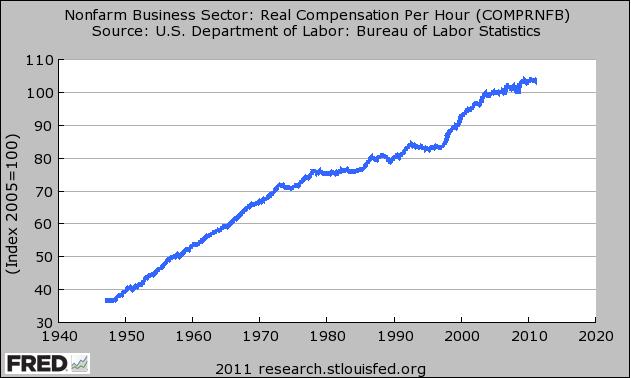
Q: You are not adding benefits to the real wage. The Bureau of Labor statistics has shown there has been a upward trend in real compensation per hour since the 1940s. Does this not explain the stagnation of wages?

It is true there has been a steady increase of real compensation (wages + benefits) per hour, below is a graph taken from the Bureau of Labor Statistics;


However, we have to look at this data with the increase in workers' output rather than by itself. Since the year 2000, there has been especially a disconnect between real compensation per hour and output. 


But this disconnect in average hourly compensation and productivity started far before the 00s; it actually began in the late 70s and got progressively worse since the Reagan years. Below is a graph from the Economic Policy Institute;


And although this graph does not show the growing gap between productivity and average hourly compensation since '07, it has gotten much worse since then. So yes, average hourly compensation has been increasing but not as nearly as the same rate as productivity has. 

-------------------------------------------------------------------------------------------------------------------------------

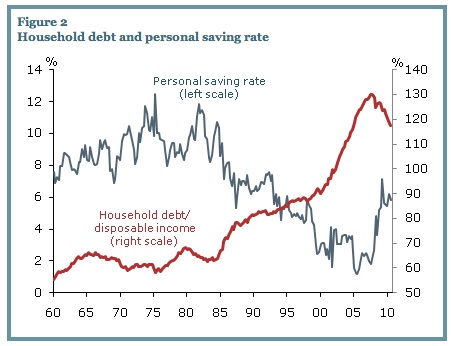
Now, for the topic of this post which may actually be shorter than the background information; Why aren't the workers mobilizing and demanding higher wages as they did in the first half of the 20th century? There are many reasons; one being the destruction of unionism during the Reagan years and another being the of spending money you don't actually have; the illusion of credit. Ever since real wages have become stagnant and the sharp decline of unionization in the 80s, there has been a sharp increase in household debt in the United States, which actually dissuades workers from demanding higher wages in some respects. It is this exploitative dichotomy that has kept corporate profits high and wages low; all in the guise of "buy now, pay later!" and 'economic growth.

Below is a graph of household debt versus persona savings taken from 'The Basis Point,' a blog by mortgage banker Julian Hebron:  


Here is a chart taken from the Federal Reserve Bank of San Francisco. It was a study pertaining to the entire United States:


Why is the middle class shrinking and being anesthetized by credit? It is this type of behavior that drives society outside of its means and gives it working class families the false perception that their wages are increases; maybe nominally they are, which is deceptive in itself, but the main hurdle we must overcome is realizing the distraction of mass consumption by credit going forward. This requires questioning this entire system which has, for the most part, become based on credit and money yet to be paid. I highly fear the collapse of this 'credit culture' and the shaky foundation it is built on; And perhaps worst of all, we are unjustly condemning future posterity to debt bondage. What happened during the crisis of 2008 we may find to become a staple in the modern 21st century economic model; and since debt wasn't properly liquidated, worse may be yet to come. The functionality of such an illusionary market method I am highly skeptical of, and its outcome will most definitely hurt the current mainstream liberal capitalist model.