Showing posts with label Keynesianism. Show all posts

Monday, August 6, 2012

Debt Deflation and Crisis

When analyzing debt and economic growth, usually only government debts are examined. They are seen as a corollary to economic crises, devaluation of currencies, and government defaults -- and while I'm not going to dispute or discuss these claims here in this post, perhaps on a later day, I will say that they are misleading trends of analyses in relation to the current financial crisis. There is another 'kind' of debt that is up for discussion and more pertinent to the crisis of 2007 -- credit market debt, which consists of domestic non-financial sectors (household debt, business/corporate debt, and government debt) and domestic financial sector debt.

This explosion of credit began around the time of the institution of 'Reaganomics,' where individuals took to lending and spending over saving despite stagnant wages. 


A more detailed look of the trend since 2002, with its peak. The shaded area depicts the length of the recession.


However, the above graphs show the total credit market debt. Broken down, household (consumer) credit debt depicts the same trend.


What does all this mean? Fundamentally, this means that the expansive economic growth of the previous three decades were on shaky footing to begin with, likely leading to the global economic collapse that followed. The impact of the credit boom since the 1980s is described in an article by the research institute Center for American Progress (CAP) by Christian E. Weller. He writes:
"The debt is highest among the middle class. Middle-income families before the crisis had a debt-to-income ratio of 155.4 percent in 2007, the last year for which data are available, for families with incomes between $62,000 and $100,000, which constituted the fourth quintile of income in our nation in 2007. This ratio is higher than for any other income group. Families in the top 20 percent of income (with incomes above $100,000) had a ratio of debt to income of 123.6 percent, and families in the third quintile (with incomes between $39,100 and $62,000) owed 130.7 percent of their income. Households in the bottom 40 percent of the income distribution (with incomes below $39,100 in 2007) owed well below 100 percent of their income."
Shocking as it is, this is the not the first time such a credit upsurge occurred. There was a similar phenomenon that occurred before the Great Depression of the 30s. Samuel Brittan, in his review of Richard Duncan's 'The New Depression: The Breakdown of the Paper Money Economy,' writes:
"It is certainly striking how both the 1929 Wall Street crash and the 2007-08 financial crisis were preceded by a huge credit explosion. Credit market debt as proportion of US gross domestic product jumped from about 160 per cent in the mid-1920s to 260 per cent in 1929-30. It then fell sharply in the 1930s to its original position. Later it surged ahead in two upswings after 1980 to reach 350 per cent of GDP in 2008."
The corresponding graphic, using the analysis by Jeffrey Gundlach, Chief Investment Officer from TCW:
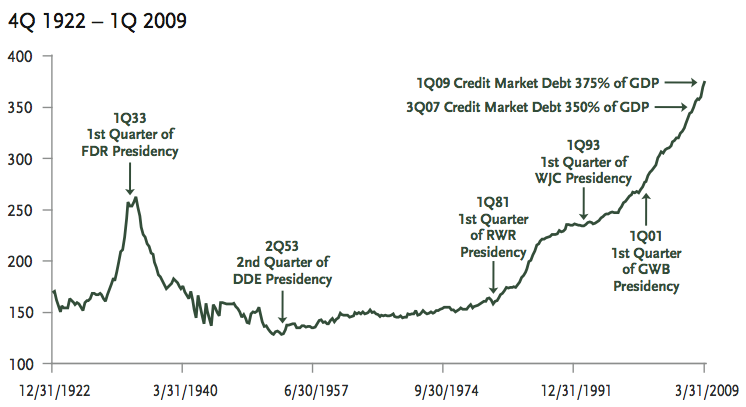

This analysis of crises in relation to credit market debt is attributed to economist Irving Fisher, and his ideas were largely ignored in favor of mainstream Keynesian view of economic crises, which argued that they were caused by an insufficiency of aggregate demand. Since the recent economic crash of 2007, Fisher's ideas have enjoyed a resurgence in economic thought. His theory on debt deflation has been of significant fascination in the heterodox Post-Keynesian school of economics, and is now beginning to enter the mainstream. Economist Paul Krugman discusses Fisher's ideas in one of his posts on his blog "Conscious of a Liberal" in the NY Times -- below is the graphic taken from the article (with added information).      

                         
Since the total credit market debt owed has been stagnant since late 2009, reaching its 'peak,' and if GDP steadily keeps rising, it is likely that debt deflation will occur all the same as it did during the Great Depression. However, the issue of private debt and its hindrance on the consumer is still an issue -- and if spending is ever to increase significantly, the issue of wages and consumer debt must be addressed.
------------------------------------------------------------------------------------------------------------
- An analysis of the total credit market debt by Crestmont Research. 

Sunday, March 11, 2012

The Future Dilemmas of Keynesian Capitalism

Although I do not believe the current economic paradigm will fully collapse on its own, since that would be naïve, there are a few problems the modern market, and even the state, cannot properly solve and Keynesians should consider:

The issue of ecology and environmentalism; during the 2009 Copenhagen Summit this was especially evident, where the state and its corporate interests failed to make any law-binding decisions. This problem has been going on for a while, where the consensus has always been “We urge people to pollute less!” without enacting any legislation to enforce that. And the inevitable collapse and depletion of the oil and the energy market, predicted to happen around 2040, will prove to be destructive to globalization.

The issue of transhumanism and the rapid advancement of biogenetics is an issue the markets will fail to control and the state will probably succumb to, which would ultimately create a physical and intellectual divide between the wealthy and the poor, aside from their socio-economic status, because only the rich will have access to such enhancements.

The issue of intangible capital; the market has always functioned on physical capital that could be exchanged in the real world, but now with the rise of digital assets (which is now worth more than real world assets) all that is changing and it seems that the current laws on intellectual property and copyright are proving to be useless. The problem comes from that regulating this kind of capital and the digital market in general is inherently intrusive and stripping of liberty. The pressure of corporations on the state to enact further laws to limit internet freedom will surely come as a result, representing a new form of censorship and Orwellian infringement of basic rights (more info here).

The issue of new forms of apartheid; Zizek discussed this in a few of his interviews, in which there is a new class of people that are just excluded from the system completely. This is becoming increasingly prevalent in South America, Africa, Asia, and even in the United States, where there are artificial barriers being set up between the slums and the rest of the nation. There is little state control in these areas, and they are completely disregarded in the political sphere and there is little hope of incorporating them back into the system since they are so disproportionately poor. A good example of these “little Berlin Walls,” that Zizek calls them, are the slums of the Romani people (the Gypsies) in Europe, specifically Eastern Europe. Just look up modern antiziganism and you will find the oppressive hatred and exclusion the Gypsies face in modern day Europe, and their rights are completely ignored in the political sphere and even by the transnational bodies like the UN, which is apparent in their reaction to Roma refugees in the aftermath of the Kosovo war. 

And finally, the issue of state interventionism is a problem in itself. I think most Keynesians would agree that if that state did not intervene the market would abolish itself; the allocative capacity of the market is just not efficient enough, especially in a world where there are more overweight people (1.5 billion) than malnourished individuals (925 million), where food is being misallocated to areas where it is not needed because of unethical profits. Industries are attracted to areas with high levels of GDP. Since the ‘Golden Age of Capitalism’ after WW2, there has been substantial growth but with this economic expansion also comes increased state involvement. This destructively centralizes democratic power rendering it useless, and increases state power to bounds that could endanger democracy in itself. Authoritarian capitalism, or ‘capitalism with Asian values,’ as is present in Singapore and China, is at this point in time working more efficiently than liberal capitalism which is something we should all be concerned with. It used to be that argument that free markets will ultimately lead to democracy eventually, but now the authoritarian way is proving to be much more efficient in many respects and that liberal argument for capitalism may soon be disproved.