Friday, April 6, 2012

The Spanish Revolutionary Spirit

As eloquently described by George Orwell in 'Homage to Catalonia:'
"...It was the first time that I had ever been in a town where the working class was in the saddle. Practically every building of any size had been seized by the workers and was draped with red flags or with the red and black flag of the Anarchists; every wall was scrawled with the hammer and sickle and with the initials of the revolutionary parties; almost every church had been gutted and its images burnt. Churches here and there were being sytematically demolished by gangs of workmen. Every shop and café had an inscription saying that it had been collectivized; even the bootblacks had been collectivized and their boxes painted red and black. Waiters and shop-walkers looked you in the face and treated you as an equal. Servile and even ceremonial forms of speech had temporarily disappeared. Nobody said 'Señor' or 'Don' or even 'Usted'; everyone called everyone else 'Comrade' and 'Thou,' and said 'Salud!' instead of 'Buenos dias.'" 
"...There were no private motor cars, they had all been commandeered, and all the trams and the taxis and much of the other transport were painted red and black. The revolutionary posters were everywhere, flaming from the walls in clean reds and blues that made the few remaining advertisements look like daubs of mud. Down the Ramblas, the wide central artery of the town where crowds of people streamed constantly to and fro, and the loud-speakers were bellowing revolutionary songs all day and far into the night. And it was the aspect of the crowds tha was queerest thing of all. In outward appearance it was a town in which the wealthy classes had practically ceased to exist. Except for a small umber of women and foreigners there were no 'well-dressed' people at all. Practically everyone wore rough working-class clothes, or blue overalls or some variant of the militia uniform. All this was queer and moving. There was much was much in it that I did not understand, in some ways I did not even like it, but I recognized it immediately as a state of affairs worth fighting for. Also I believed that things were as they appeared, that this was really a workers' State.." 
Info on worker's self-management in the public transportation system of anarchist Catalonia can be found here. Also more general info on the Spanish anarchist experiment can be found by clicking on this link, here.

The Politics of Historical Revisionism

The American republic has been steadily degenerating in recent years - and it seems some want to resuscitate some lost patriotic zeal of the American dream with obscurity and contradictions. A deliberate false historic revisionism is happening; a 'rereading' of American history in an effort to make it fit with today's United States. This is the modern system that the founders envisioned, they argue, and we have to keep the status quo 'alive and well.' They are trying to put a square peg in a round hole and they have an entire rightist movement fooled. 

Thomas Jefferson, especially, has become a victim to this type of slander. He is portrayed, by the Tea Party and others, in cliché slogans of little to no historical significance. He is used falsely as a rallying call for free market-eteers; serving as an example that the United States was founded on the principles of "modern capitalism and democracy" and that this "still lives on today." In recent memory, he has been attributed to this false quote:
"The democracy will cease to exist when you take away from those who are willing to work and give to those who would not,"
Fits right into the right-wing anti-Obama agenda, seldom a surprise.

Thomas Paine's real reputation has also been ravaged and hijacked, even recently. The former conservative TV host Glenn Beck used to pride himself on being a scholar of the American founding fathers. He attempted to christen Thomas Paine as the new figure of conservatism - an obvious contradiction to anybody with a vague recollection of American revolutionary history. Thomas Paine was a radical leftist, an enemy of privilege and aristocracy, an anti-religious pamphleteer, a skeptic of capital accumulation, and a contrarian of his time. He died penniless and with little friends, a testament to his passion; in no alternate world would he ally himself with a wealthy Christian-conservative TV star. Not only that, he is diametrically opposed to the domestic conservative platform. He is credited as the precursor to the modern 'Social Security System,' in his work titled 'Agrarian Justice' he writes:
"In taking the matter upon this ground, the first principle of civilization ought to have been, and ought still to be, that the condition of every person born into the world, after a state of civilization commences, ought not to be worse than if he had been born before that period."
He goes on to advocate a 'National Fund' to guarantee such improvement:
"To create a national fund, out of which there shall be paid to every person, when arrived at the age of twenty-one years, the sum of fifteen pounds sterling, as a compensation in part, for the loss of his or her natural inheritance, by the introduction of the system of landed property:
And also, the sum of ten pounds per annum, during life, to every person now living, of the age of fifty years, and to all others as they shall arrive at that age."
He then goes into monetary details; breaking down costs in Britain at the time and how the system would be implemented. He also criticizes the institution the private property as being naturally restrictive and, if left to its own ends, would accumulate to a minority elite. He promoted his 'National Fund' idea to cure this malady of capitalism; and bear in mind this was formulated in a predominately pre-capitalist era. This was written over two centuries ahead of his time, remarkable in any respect.

Now, does this correspond with any right-wing rhetoric? This historical obscurity is a symptom of a broken political sphere where revisionism is deemed a valid strategy; this becoming the rule rather than the exception. Trying to push a ideology of 'American Exceptionalism' by disguising the historicity of American figures is dangerous in hindsight for it fools the public into believing that the modern status quo is what was intended at this nation's founding. It is this that perhaps, albeit subtly, discredits anybody questioning today's illusive 'American Dream.' The response has become "you're going against the American tradition." This is a kind of political religion, a type of dogma, and a false one at that.

And one just as the founders intended, surely - or so these modern 'patriots' claim. 

Monday, April 2, 2012

The Credit Illusion

It seems that the United States has grown economically, for the most part, throughout all of its history. And for much of its history, this growth was accompanied by corresponding increases in real wages. It was assumed that with economic growth, the purchasing power of your wage for all your hard work would pay off and it would increase with time; it was part of the American Dream.


Ever since the 60s, real wages have remained mostly stagnant  - even taking a downward trend in the past year. Although maybe our nominal wages have increased, our real wages have remained the same and even more alarming the purchasing power of income has plummeted. Even worse so, the price of food and energy has gone up in recent years and we're still working the same amount of hours, sometimes more. Where is the improvement and, most importantly, why is the middle class shrinking? Although all this issues would usually mean a rise in unionization amongst workers and rallies to demand for higher wages/benefits and perhaps more equal distribution of wealth, as happened during the Great Depression and the 1910s, union membership has actually paradoxically decreased in the last 50 years.The Bureau of Labor Statistics reports that only 6.9% of workers in the private sector are union members. 


Although I've oftentimes heard the right demonize unions as dangerous to the delicate fabric of a free market, and oftentimes advocate enacting legislation to curb their power, there is no question the decrease in union membership has had a direct effect on the concentration of wealth in the United States and the middle class share of aggregate income. Here is are the results that were found by Karla Waters and David Madland of the at the Center for American Progress (CAP):


Now, before I get to the credit illusion, which is likely the culprit, first we have to dispel a few arguments against the stagnation of real wages in the United States - three of them specifically I want to talk about;

Q: Well, maybe workers' productivity has not increased and their real wages are a direct result of a stagnation in their output?

This cannot be true, hourly outputs per workers have actually been steadily increasing. This is based on information from the Bureau of Labor Statistics and Bureau of Economic Analysis; there is indeed a growing gap between output and real wages: 


Q: The average income per household has gone up, isn't that inconsistent in the stagnation of real wages? 

No, it is not. The Second Wave of feminism, which started in the early 60s, brought many more women to the workforce. It's not that the workers are bringing more real income home, it's that more people are working in the household. In an article in the journal article by Rebecca A. Clay of the American Psychological Association:
In 1940, according to the Employment Policy Foundation's Center for Work and Family Balance, 66 percent of working households consisted of single-earner married couples. By 2000, that percentage had dropped to less than 25 percent. By 2030, the center estimates, a mere 17 percent of households will conform to the traditional "Ozzie and Harriet" model.
It is this phenomenon that has caused an increase in average income per household - there are now many more new sources income per family, but that doesn't necessarily tell us anything about the average real wage for each individual bringing it home.

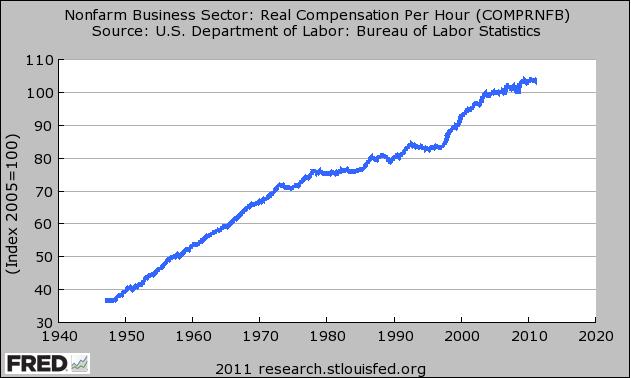
Q: You are not adding benefits to the real wage. The Bureau of Labor statistics has shown there has been a upward trend in real compensation per hour since the 1940s. Does this not explain the stagnation of wages?

It is true there has been a steady increase of real compensation (wages + benefits) per hour, below is a graph taken from the Bureau of Labor Statistics;


However, we have to look at this data with the increase in workers' output rather than by itself. Since the year 2000, there has been especially a disconnect between real compensation per hour and output. 


But this disconnect in average hourly compensation and productivity started far before the 00s; it actually began in the late 70s and got progressively worse since the Reagan years. Below is a graph from the Economic Policy Institute;


And although this graph does not show the growing gap between productivity and average hourly compensation since '07, it has gotten much worse since then. So yes, average hourly compensation has been increasing but not as nearly as the same rate as productivity has. 

-------------------------------------------------------------------------------------------------------------------------------

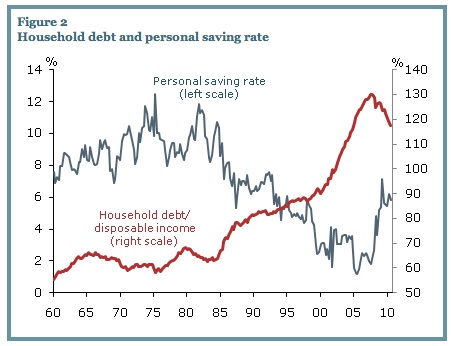
Now, for the topic of this post which may actually be shorter than the background information; Why aren't the workers mobilizing and demanding higher wages as they did in the first half of the 20th century? There are many reasons; one being the destruction of unionism during the Reagan years and another being the of spending money you don't actually have; the illusion of credit. Ever since real wages have become stagnant and the sharp decline of unionization in the 80s, there has been a sharp increase in household debt in the United States, which actually dissuades workers from demanding higher wages in some respects. It is this exploitative dichotomy that has kept corporate profits high and wages low; all in the guise of "buy now, pay later!" and 'economic growth.

Below is a graph of household debt versus persona savings taken from 'The Basis Point,' a blog by mortgage banker Julian Hebron:  


Here is a chart taken from the Federal Reserve Bank of San Francisco. It was a study pertaining to the entire United States:


Why is the middle class shrinking and being anesthetized by credit? It is this type of behavior that drives society outside of its means and gives it working class families the false perception that their wages are increases; maybe nominally they are, which is deceptive in itself, but the main hurdle we must overcome is realizing the distraction of mass consumption by credit going forward. This requires questioning this entire system which has, for the most part, become based on credit and money yet to be paid. I highly fear the collapse of this 'credit culture' and the shaky foundation it is built on; And perhaps worst of all, we are unjustly condemning future posterity to debt bondage. What happened during the crisis of 2008 we may find to become a staple in the modern 21st century economic model; and since debt wasn't properly liquidated, worse may be yet to come. The functionality of such an illusionary market method I am highly skeptical of, and its outcome will most definitely hurt the current mainstream liberal capitalist model. 

Sunday, April 1, 2012

Free Trade in Death

The United States is often credited with reaching global economic status with free trade; that laissez faire capitalism and open trade with all nations brought us to modernity.

In actuality though, protectionism was vital in establishing American economic dominance and hegemony. The American System first promulgated by Henry Clay was critical of the British variant of economic thought and advocated high tariffs, a central bank, and federal subsidization of internal improvements (i.e canals, schooling, roads) amongst other things. It was built on Hamiltonian principles and the infant industry argument - that smaller industries must be protected from larger foreign competitors because they do not have the monetary means to compete. 

Usually this put regional interests at end and created a bitter American divide - the North wanted high tariffs and subsidization and the South wanted complete free trade to be able to sell its goods (predominately cotton) to Britain and other foreign markets. It was one of the main causes of the Civil War; the clash of economic ideologies. South's dependence on foreign markets was so strong that it firmly believed it could fully sustain itself without the North's industry. The "King Cotton" ideology was used as a slogan to convince Southern public opinion; Southern legislatures promoted the message that since Britain's and France's dependence on Southern cotton for their textile mills was so strong, they would be forced to aid them in their struggle of secession. As the Union began blocking Southern seaports, this rallying call proved to be unfounded - foreign markets just found elsewhere to purchase cotton. The British Empire turned back to its colonies for cotton markets. India increased its cotton production by 700% and Egypt did likewise. The South was severely crippled and took many decades to recover. In addition, their laissez faire ideology was downgraded. The Republican (former Whig) American System became the dominant school of economic thought.

Average tariffs percentages were at their highest from 1865 - 1900; when the United States underwent its second Industrial Revolution. Despite the predictions of the powers of Europe, who believed the American Experiment would never recuperate from the Civil War, the United States underwent the one of the greatest economic growth periods in its history and established itself as a great power and then ultimately, much later, as a superpower. The Gilded Age ensued, which was arguable one of the most corporate-concentrated periods of power in U.S history; where the pervading ideology was that the wealthy were the "best of society" and the poor "did not work hard enough." It was this concept that gave rise to the illusion of the American Dream and dissuaded the working class from mobilizing, in some respects. It worked in the interests of the wealthy most definitely. 

But aside from that, in looking at today's economic situation; why are we imposing free trade on other developing nations if we did not prosper from it ourselves when we were emerging as a power? The IMF and its associate organizations parade around promoting free trade and pressuring other nations to open to foreign capital only to further fill the pockets of the Western ruling class, and further impoverishing those not in high positions of power. 

In South America, locals have been exploited for over a century by foreign ownership of land. Many of the legislatures have been complicit with the policies of the United States and the West and allowed for large corporate entities to buy out land; usually unused and to save for "later use." Is this the benefit of free trade? The disproportionate ownership of global assets by Western powers? To make matters worse, a failure to allow foreign capital can have disastrous consequences. Many Latin American countries had coups staged, usually led by American interests, to halt any redistributing of land to the peasants. It is apparent that the First World depends on the Third World's impoverished state to maintain their hegemony and economic superiority; they want these impoverished nations to remain dependent on their capital and investment. Well-calculated and planned underdevelopment, as its called. 

But it seems that the leftist streak in Latin America may be changing this, hopefully soon. Some Latin American countries have already enacted legislation to redistribute unused private land to the poor, such as Hugo Chavez's Plan Zamora in Venezuela. As of now, much of Latin American land remains in the hands of foreign investors. In Uruguay, the 2000 census showed that 17 percent of its arable land was foreign-owned, but it is predicted to be 20 to 30 percent today.  In Brazil, the Brazilian Institute for Colonization and Agrarian Reform estimates that 4.5 million hectares are owned by foreigners - but this figure is low and it may be twice as large, according to government officials. Argentinian authorities place its national estimates at 17 million hectares, about 10 percent of Argentinian territory, and about half of all arable land. 

Moreover, sometimes when the land is returned back to "local hands" they're heavily concentrated. The Landless Worker's Movement in Brazil estimates, according to 1996 census records, that just 3% of the populations owns two-thirds of all arable land in Brazil. This only disempowers the majority and furthers economic inequality. According to World Development Indicators [2000] 10% of the population owns 47.6% of the wealth in Brazil. A study done by the Instituto de Pesquisa Econômica Aplicada (Institute of Applied Economic Research or IPEA) paints a even grimer picture "...in São Paulo the wealthiest 10% had 73.4% of while in Rio they retained 62.9% and in Salvador 67%." A product of unequal land distribution caused by free trade and neo-colonialism, it seems.

The moral of the story; modern free trade is not fair trade. Business clusters that congregate around areas of high GDP are inherently exploitative of poorer regions, taking their land disproportionately. The last things these emerging nations want is foreign capital owning their assets and preventing them from prospering. This forced underdevelopment is imposed through laissez faire legislation, and kept in place by multiple transnational organizations that preach the same ideology. It is dangerous to the self-determination of peoples and their long-term prosperity. It is exploitative by nature, but it seems that some free market fundamentalists just cannot abandon their distorted dream. And then their obscurities are imposed on the rest of us, with disastrous global economic consequences. 

More info on the land crisis of Latin American can be found here and here. Statistics and general info on Brazil's widening wealth gap and poverty crisis can be found here.