Friday, March 30, 2012

Anomie and Revolution

Sometimes in the heat of revolutionary change, unspeakable atrocities are committed. Individuals look back in horror at what was inflicted and are unable to comprehend how citizens could go into such a collective state of irrationality. This societal dilemma is called an issue of anomie, which is described as a state of normlessness; where there is a rejection of self-regulatory values and any distinction between right and wrong, for the moment, become obsolete. 

David Émile Durkheim, one of the fathers of modern sociology, coined the term 'anomie' in 1897 in his book 'Suicide' and describes it as a "a rule that is a lack of a rule." A society can become anomic for a variety of reasons, but it is always preceded by a dissatisfaction with the current set of affairs. In essence, the people's will to change the old order overcomes their rational instincts and makes them primitive peoples; regressing them from their modern consciousness. It is this phenomenon that is perhaps an obstacle to major revolutionary change, if done too hastily; since people loose their moral senses, their ability to recognize an emerging despotism all the more diminishes. This can have devastating consequences to the society after the initial short-lived euphoria of change.

One prevalent detailed precursor to 'collective anomie' is distorted idealismThe German Romantic author, Jean Paul, called this relationship of the mind and earth Weltschmerz - the grim understanding that the demands of the mind cannot be met in the physical world and that one's weaknesses are a direct result of his relationship with the cruelty of what he witnesses and experiences. There are seemingly two dark paths that can follow; either the individual enters a state of escapist mentality and seclusion or develops an anomic response that renders him incapable of self-regulating his values. The former is much less socially destructive, since it is individualistic, and is much more prevalent; it is known as Hikikimori in psychological studies and oftentimes is caused by post-industrialism and its implications. It is especially present in modern day Japan, given the origin of the word itself; affecting about 3.6 million.

The anomic response to Weltschmerz holds a much greater societal cost. Although individual anomie is dubbed "sociopathic," collective anomie is much more radical; it is the destruction of norms and values - and seemingly, for that time being, the destruction of morality. This deregulation of morals is often seen in war and violent struggles. It was present in the Yugoslav Wars, where Serbian soldiers in newly declared states of Croatia and the Bosnia would massacre citizens of non-Serbian ethnicity - for little reason other than ethic cleansing. 

A complex dilemma arises when you examine their actions; where did their moral consciousness go, and how could these seemingly 'civilized' peoples engage in such irrational violence? 

Oftentimes, when individuals are given authority they feel inclined to maximize their power; the Serbian military was in a position of dominance, and they felt they needed to fully exert their power, no matter the ethical implications, for their 'nationalistic common good." They had no limits; they were in a state of anomie. And moreover, war usually causes irrationality in the soldiers themselves, affecting their decision-making and their state of mind. It drives soldiers to do inexplicable acts - some so heinous they're difficult to comprehend. In Bosnia during the Yugoslav War, rape was used as 'an instrument of terror' by the Serbian-Bosnians. The victims were usually Bosniaks (Bosnian Muslims) of the region. It illustrated a total suspension of ethics and is difficult even to describe in words. Young Bosnian girls were sold and passed around in predominately Serbian infantry lines for rape, torture, and sometimes death - the majority of this happening the region of Foča in Bosnia & Herzegovina. There were specific camps designated for rape and torture, driven by religious and ethnic hatred. Young females were systematically brought to the camps, raped & tortured, and traded to other soldiers for money or just general 'enjoyment.' In the submitted 'Seventh Report on War Crimes in the Former Yugoslavia: Part II" the atrocities are described in grim detail:
"Day and night, soldiers came to the house taking two to three women at a time. They were four to five guards at all times, all local Foča Serbs. The woman knew the rapes would begin when 'Mars na Drinu' was played over the loudspeaker of the main mosque.." 
"..While 'Mars na Drinu' was playing, the women were ordered to strip and soldiers entered the homes taking the ones they wanted. The age of women taken ranged from 12 to 60. Frequently the soldiers would seek out mother and daughter combinations. Many of the women were severely beaten during the rapes."
The song 'Mars na Drinu' was a Serbian-Chetnik patriot song that was banned under Tito in socialist Yugoslavia. To illustrate the ethnic dimension even further, the report goes in more personal detail of the rapes:
"While the witness was being raped, her rapist told her, 'You should have already left this town. We'll make you have Serbian babies who will be Christians.' Two soldiers raped her at that time; [And then] five soldiers raped the 18-year-old girl in full view of the witness."
You can read the this particular war crimes report in full here. Also, an interview of Seada Vranic, the author of 'Breaking the Wall of Silence,' can be found here. She is a renowned journalist who has covered the mass rape that occurred during the Bosnian War. 

Now, the frightening question still remains; what caused these individuals to lose their sense of humanity? What desensitized them to the point of violence and rape? The collapse of their moral environment, their racially-idealist attempt to realize their nationalist goals, and the elimination of social values all contributed to their irrationality. They became submissive to 'herd mentality' that was formed on 'rules that lack rules' - there was no moral direction. It is this, I fear, that any form of disorganized violence could bring. This form of irrational collectivism is dangerous, and if any revolutionary change is brought it must be properly handled to prevent such a tragedy, in the true Aristotelian sense of the word, from happening. 

Monday, March 26, 2012

Youthful Super-Patriotism

Today, while I was fidgeting around with the American flag, I kindly asked my youngest 6 year old brother to say the Pledge of Allegiance, not expecting much. He said it word for word and, despite irregular pauses between phrases, managed to recite it fully and was overly-content when he finished.

I then asked him what it meant, and I was sincerely surprised at his answer even though I should have known better; he didn't have the slightest idea. He was just telling it as he was taught in school, without any any comprehension of what he was proudly repeating every morning in school.

Quite frankly, this is seemingly a product of - to borrow a word from the lexicon of Michael Parenti - Superpatriotism. He describes it in these words;
Superpatriots are those people who place national pride and American supremacy above every other public consideration, those who follow leaders uncritically, especially in their war policies abroad.
Parenti goes on to describe it ideologically in more detail;
The superpatriot's America is a simplified ideological abstraction, an emotive symbol represented by other abstract symbols like the flag. It is the object of a faithlike devotion, unencumbered by honest history. For the superpatriot, those who do not share in this uncritical Americanism ought to go live in some other country.
Is the American school system raising a passive society of 'Superpatriots?' Although too young to understand ideological connotations and public policy or to form their own opinions, one of first lessons in elementary education is instilling vibrant nationalism, indulging them in 'American Exceptionalism,' and learning the Pledge of Allegiance. This, to me, is nationalistic madness because it is this type of ideology that drives self-destructive policies and cultivates, either intentionally or not, a breed of obedience that is dangerous to civic duties and functions.

This 'you are either with or against us' nationalist fervor is a true danger to a societal vigilance; if anything nationalism should be reasoned, discussed, and accepted voluntarily (if even that) at a certain coming of age, not imposed on the feeblest of minds.

Moreover, why are we replacing skepticism with blind love of the state? As Howard Zinn profoundly said; "Dissent is the greatest form of patriotism!" and I am sure any real patriot that established the American Experiment that shook the world in the 18th century would wholeheartedly agree.

Sunday, March 25, 2012

The 18th Century Radical

In the 18th century Europe underwent a cultural and intellectual; sometimes rather violent; revolution that took it to a new form of consciousness and populist fervor. The Enlightenment was a pivotal step in human development, which freed it from the shackles of superstitions and divine titles of power. In Immanuel Kant's essay "Answering the Question: What is Enlightenment," he calls it;
Mankind's final coming of age, the emancipation of the human consciousness from an immature state of ignorance and error.
It is from this ideology, and its logical conclusions, the radical was born. Radicalism in the 18th century was much more than a realization that man's mind is his greatest tool; it involved being skeptical of the entire system and the very existence of entitlement, aristocracy, and power. And moreover, it was was the realization that liberty is seldom a vice.

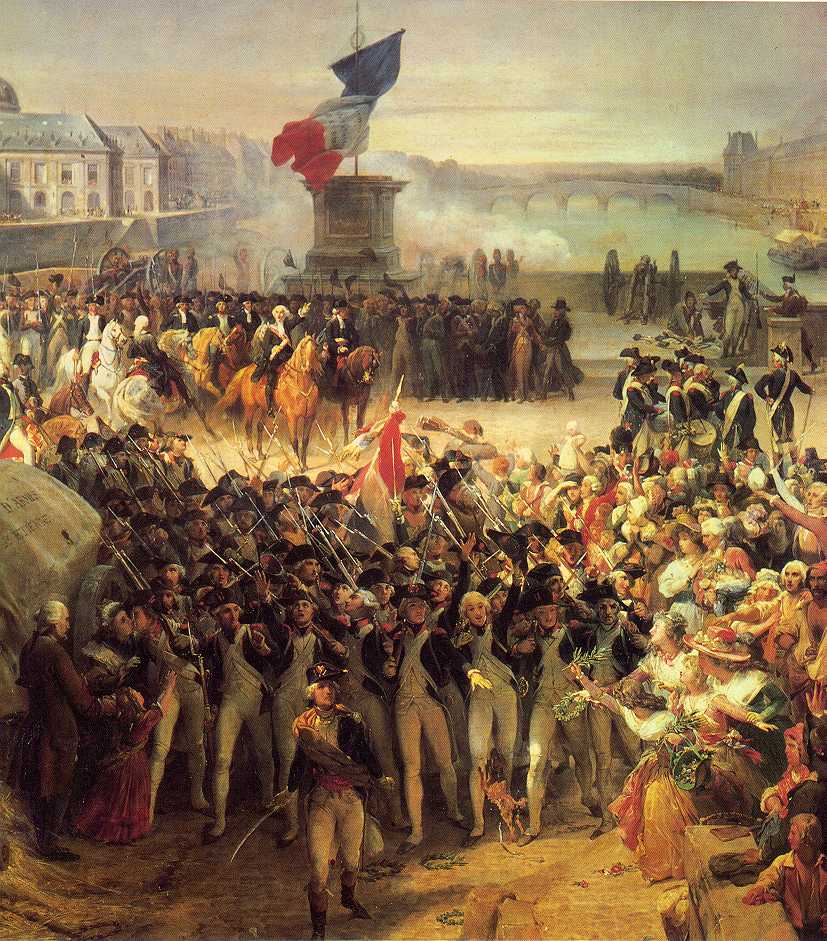
Oftentimes, radicalism would violently clash with the forces they were working against; The French Revolution was a climactic bloodbath after centuries of feudal and royal rule - a rebellion against the divinely sanctioned institutions that was oppressing the commoner. It was the first truly violent overthrow of old order based on Enlightenment principles (the American Revolution was arguably not quite as great of an social upheaval), and ushered in the principles of inalienable natural rights, equality of peoples, and 'universal' citizenship. It was also perhaps the first time in Europe that the labouring class was successively mass-mobilized against aristocracy and oppression in regiments called the Sans-culottes; which favored revolutionary proto-Marxist ideas such as socio-economic equality, anti-free market ideologies, direct democracy, and availability of affordable necessities. Radical even by today's imagination.

Sadly many of these egalitarian Enlightenment attitudes evaporated in the aftermath of the Reign of Terror that ensued after the French Revolution, led by Maximilien "The Incorruptible" Robespierre, albeit some were kept alive in the United States in the years following the American Revolution. The Declaration of the Rights of Man however, the most beautiful creation during the French Revolution, seemingly lived on; standing as the ultimate testament to Enlightenment idealism inspired by the works of Jean-Jacques Roussaeu, Baron de Montesquieu, John Locke, and the American Revolution. It espoused in Article I, eloquently;

Men are born and remain free and equal in rights. Social distinctions may be founded only upon the general good.
Although improperly put in practice, it served as an ideal and a reason for struggle for the French in years that followed, especially in the Revolution of 1848.

In the United States, many American radicals were in solidarity with the French struggle for equality, but were somewhat saddened by the widespread violence. Thomas Jefferson, a radical of the Enlightenment and father of the American republic, wrote very favorably of the French in principle, and was captivated by their vigor and passion, but could not ignore the bloodshed and killings of the 'counter-revolutionaries.' He writes in a private letter to American ambassador William Short;

The liberty of the whole earth was depending on the issue of the contest, and was ever such a prize won with so little innocent blood? My own affections have been deeply wounded by some of the martyrs to this cause, but rather than it should have failed, I would have seen half the earth desolated. Were there but an Adam and an Eve left in every country, and left free, it would be better than as it now is. I have expressed to you my sentiments, because they are really those of 99 in an hundred of our citizens. The universal feasts, and rejoicings which have lately been had on account of the successes of the French shewed the genuine effusions of their hearts. You have been wounded by the sufferings of your friends, and have by this circumstance been hurried into a temper of mind which would be extremely disrelished if known to your countrymen [1793].
Despite the violence, Jefferson remained optimistic of the ultimate end of despotism and tyranny. He writes in great hope and admiration commenting on the ongoing struggle in the French Republic and the Batavian Republic of Holland in a letter to Tench Coxe;
This ball of liberty, I believe most piously, is now so well in motion that it will roll round the globe, at least the enlightened part of it, for light & liberty go together. It is our glory that we first put it into motion [1795].
This Jeffersonian idealism 'lives on', or rather should, in principle and in policy. The intellectual triumphs of the American and French Revolutions should not be forgotten nor ignored; and the principles written in John Locke's Second Treatise on Civil Government, on which Enlightenment social precepts were founded on and which Jefferson revered, will always stand true;
The natural liberty of man is to be free from any superior power on earth, and not to be under the will or legislative authority of man, but to have only the law of nature for his rule.
It is on this basis that a free democratic society is formed and it is likewise why natural rights should never be forgone - no matter how noble the end result.